Hey everybody! I thought it would be helpful to you all if I shared this online game that I used to get better at the pen tool. I'll warn you, though, it gets pretty difficult, but you learn A LOT from it.
I'll also give you this link to a page of online games that are meant for creative graphic designers. They're fun, helpful, and wicked competitive. I'm not kidding. I've lost friends because of some of these games.
And last, but not least, Lynda.com is now free for IC students so I highly suggest going on and checking out the After Effects Essential Training course.
Showing posts with label games. Show all posts
Showing posts with label games. Show all posts
Wednesday, January 27, 2016

Friday, November 14, 2014
Pre-rendered Backgrounds (And why they're your computer's friends!)
Video games are fun. They also contain a lot of polygons. We like polygons, they look nice! But computers (this includes game systems) don't like polygons. They take time and energy to render, and in a game, things are rendering all the time!
 Why does a game from 2002 look so much better than one from 1996? Well, a big part of that is what the computers at the time were able to do. Games today have crazy high polycounts (that's how many polygons) compared to games from even just 5 years ago.
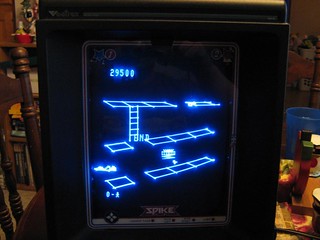
So, where do the polygons begin? Is it with the Vectrex? That thing did have some rockin' vector graphics.
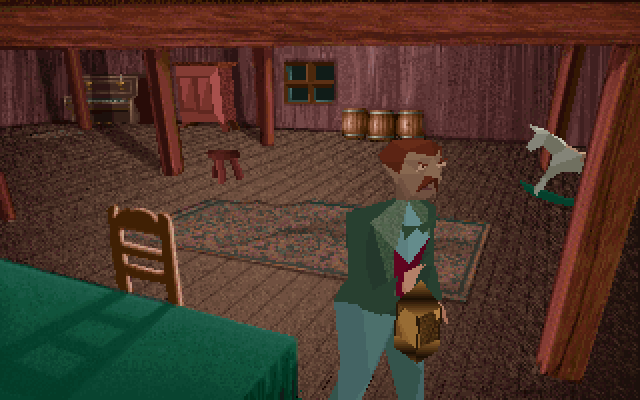
Others contest that is was 1992's survival horror game, "Alone in The Dark" for DOS and later the 3DO.
 Alone in the dark was ambitious. It had fully animated 3D models for characters, enemies, items, all sorts of things.
 So, part of what made Alone in The Dark possible, was the use of pre-rendered backgrounds. This means that the background does not move with the game, but rather is a still image or series of images. This allowed for vibrant, 3D looking backgrounds.
Pre-rendered backgrounds were most common in DOS/PC, Playstation and various Saturn games of the 90s and early 2000s.
Pre-rendered backgrounds are still used today, often in indie games. Scott Cawthon (Who I've mentioned before) uses them in all of his games.
Today, the use of a pre-rendered background may be a stylistic choice as opposed to a limitations one. It's a clever way to get more polygon bang for your buck that today is seen as iconic of those games of old. To close, here's some awesome examples of pre-rendered backgrounds old and new.


So, where do the polygons begin? Is it with the Vectrex? That thing did have some rockin' vector graphics.
The Vectrex's rockin' vector graphics in action
Others contest that is was 1992's survival horror game, "Alone in The Dark" for DOS and later the 3DO.

Pre-rendered backgrounds were most common in DOS/PC, Playstation and various Saturn games of the 90s and early 2000s.
Pre-rendered backgrounds are still used today, often in indie games. Scott Cawthon (Who I've mentioned before) uses them in all of his games.
Today, the use of a pre-rendered background may be a stylistic choice as opposed to a limitations one. It's a clever way to get more polygon bang for your buck that today is seen as iconic of those games of old. To close, here's some awesome examples of pre-rendered backgrounds old and new.

Super Mario RPG 1996
Five Nights at Freddy's 2 2014
-7.jpg)
Darkseed 2 1995
Friday, October 10, 2014
Early Gaming Animation - Duck Hunt
It is interesting to see how far animation has come from the early stages of "Flipbook" style animation to modern computer software that can animate and render entire new worlds in a few hours. I have looked at early animation earlier in this blog like "Steamboat Willie", and then I looked at modern gaming animation with "Wolfenstein". But this post I chose to look back at early gaming with "Duck Hunt". This game was part of the first era of realistic gaming, because the controller was a gun that you could use to point at the ducks flying in the game. You were able to actually shoot at the screen and kill the ducks - all virtually. It was an interesting development in technology, as well as animation, because the game creators had to animate their game to mimic real life (such as feathers flying off of the duck when it is hit, and the duck falling out of the sky). The animators had to create several options of animations for every action that could possibly happen in the game. I think the result was a fun, realistic game that was ground-breaking for the time.
Friday, October 3, 2014
Wolfenstein - Animation in Games
This week I chose to talk about animation in video games. These days video games are having more and more "cut scenes" where the player has little to no control over the character's actions and just watches a scene unfold. These scenes are powered by animation and in most cases are much more realistic than the actual gameplay. In the video below, you can see both cinematic cut scenes and gameplay, which shows the difference in animation style and visual impact. *WARNING* the video is extremely graphic, showing gruesome, violent scenes.
I think the animation here is highly sophisticated, using different camera angles and lighting techniques that make the characters come to life. For contrast, I'm putting the original Wolfenstein game below - Wolfenstein 3D.
I think the animation here is highly sophisticated, using different camera angles and lighting techniques that make the characters come to life. For contrast, I'm putting the original Wolfenstein game below - Wolfenstein 3D.
Thursday, May 1, 2014
Trans-media storytelling vs. Traditional storytelling
It’s interesting to watch the change in how stories are
being told. Traditional story telling tends to be boring while trans-media
storytelling tends to be more entertaining. Today we tell stories across
multiple means of media because a single for of media is not as entertaining.
People enjoy being able to read a book, watch the movie on it as well as play
their games. With technology being so
prominent in our society people are going to fish for content all over the Internet.
Hoping to find games to match the books and/or movies they’ve read and/or seen.
Here’s a chart of franchise trans-media. This chart shows you how multiple platforms
create a collection of individual experiences:

This is another image of traditional storytelling vs. trans-media
storytelling:

Thursday, March 7, 2013
This technology is very cool. Supposedly it is 100 time more accurate than “Kinect” for Microsoft's game system, Xbox. With this new technology, there is a system of cameras, sensors, and inferred light emitting diodes that all interact to make this possible. Also unlike other existing systems, such as “Kinect,” Leap Motion can track up to ten fingers all at once in a three-dimensional area of about eight cubic feet! The largest difference between this technology and others, is that this device is placed below that tracking area, whereas many others are placed in front of it, looking straight on. It is compatible with Apple and PC and just plugs into the computer. There are also countless applications for the technology including gaming, modeling and numerous others. The product will me available in the market on May 13th, which makes things all the better!
Saturday, February 4, 2012
UbiArt
I love video games and I've been playing a lot of Rayman Origins recently. I've always been a fan of the Rayman game series but this particular game grabs me with a fantastic art style. This art style is not only unique for the Rayman series but for games in general. "Beautiful" does not even begin to describe the art, just see the trailer below:
I really wanted to learn how the art for the game was created and after some research I came across quite a surprise. Ubisoft, the company behind the Rayman series, actually developed a fantastic new art engine called UbiArt and used it for this game. The story behind UbiArt is even cooler, Ubisoft wanted to create an animation system that can be used with ANY visual source and they succeeded! UbiArt can work with anything from crayons and ink to clay and 3D renderings. The tool primarily works by letting animators import content with ease, add skeletons to their chosen medium, and easily animate by establishing poses the tool then processes into animations. A more technical description was found on the UbiArt blog:
I really wanted to learn how the art for the game was created and after some research I came across quite a surprise. Ubisoft, the company behind the Rayman series, actually developed a fantastic new art engine called UbiArt and used it for this game. The story behind UbiArt is even cooler, Ubisoft wanted to create an animation system that can be used with ANY visual source and they succeeded! UbiArt can work with anything from crayons and ink to clay and 3D renderings. The tool primarily works by letting animators import content with ease, add skeletons to their chosen medium, and easily animate by establishing poses the tool then processes into animations. A more technical description was found on the UbiArt blog:
These next two videos provide great explanations of the UbiArt tool. The first shows some Ubisoft staff collaborating and using UbiArt and the second video has a nice intro to what UbiArt is before cutting to the Rayman Origins game trailer show above."...we use 2D patches to contort sections of the image with a level of complexity that can adapt to the potential needs of the final rendering and the target machine. This technique adapts remarkably well to this type of animation and gives excellent performances in a real-time context."
Wednesday, January 26, 2011
fun and mindless
Here is a link to the random music generator I was playing with in class. Such a fun and mindless toy, I could play with it for hours. If you're looking to kill some time this link will take you to the page where I found "Ball Droppings". It showcases what their making with Processing.js. The program looks like a mash-up of processing and java. Yeah, nobody really wants to play with code and set parameters, well at least I rarely do, but we all love a little distraction.
Subscribe to:
Posts
(
Atom
)