Paperman is an Oscar Winning Disney short, directed by John Kahrs.
The story of animation is both charming and heartwarming, however it is the thought behind the animations that makes this short interesting.
Arriving at Disney, Khars talks about his appreciation for the hand drawings that go into the brainstorming of animations. He points out the "expressive" marks and the "simplicity" of the drawings that make these drawings unique.
This inspired Khars to try and find a way to incorporate the drawings from the preproduction of Paperman into the CG effects that would later become the animation. CG and photorealistic animations seemed to make up the majority of content being produced nowadays. Kahrs tried to imagine an animation that could be different. Paper man carries the drawings along with the CG effects, to create a beautiful and refreshingly different film.
I've always been a huge fan of drawn animation and have wanted to take a stab at it for a long time. The process has always been fascinating to me. I remember watching some animation features from Disney films when I was younger that almost made me want to go into animating (I love it but I'm not sure I'm up to the task of having it as a career).
For some reason I never thought to look at modern cartoons and shorts and their process! From rough drafts to final animation. Here are a few that I found that emphasize the effort and labor that goes into creating even a couple seconds of hand drawn animation.
The music video for the song Ghosts Are Dancing by Home and Dry is exactly the kind of multimedia art and originality that gets me excited. Essentially a series of animated portraits, this animation done by the Teresuac group was created in the program Houdini. Obviously a mix of hand-created media and computer animation, the project is beautiful and creative, very inspiring for the direction I am heading in with my work!
One of my favorite music videos is Breakbot's "Baby I'm Yours". The shimmering colors and shifting shapes are hypnotic and go along with the music so perfectly. For my next project I'm working on a mini music video that uses this technique, although mine will be a lot less cool than this. I think it's interesting when artists use other mediums for rotoscoping like watercolor or gouache.
Breakbot generally has really cool animated music videos so if you like this one, I'd definitely recommend looking at their other ones.
When looking to do my second project for class, I couldn't help but be drawn to the Juno opening credit sequence. It's fun and crafty looking in a hand drawn and original kind of way. So, I thought it'd be cool to try out. Little did I know how much effort was put into the sequence. Apparently, they filmed the actress, printed out each frame as photos, outlined them in pen, photocopied them, hand-coloured them, cut them out, and scanned and composited them in a way that would take me forever and ever to do. Luckily for me, I found a much simpler way to do it through a tutorial I found online, so hopefully I'll be able to figure it out.
I pull open the door to Master Control. They see me and immediately begin typing on the computer--they know exactly what I'm here for.
"Hi, I'd like to take out the animation room--room 147--" I say, just to be polite.
"We know." They say. "It's your home now."
I've been living in my animation cave for weeks now. Hand drawn animation is going to be fun! I had said to myself. I wasn't entirely wrong but I wasn't right either.
Hand drawn animation is both intensely satisfying and incredibly frustrating. I could be there until 11pm (and I often am) and still only get a few frames done. Mostly because I have no idea what I'm doing...but still.
If you're like me (incredibly stubborn and love to live in a tiny room with a computer) then hand drawn animation is for you!
Here's a little clip to show you all what it feels like:
One debate topic that has been bouncing around in my head for the past week or so is the topic of which looks better: practical effects in filmmaking, or digital effects done in post production. There are many examples to fuel each side of the debate; like how you can empathize with puppet Yoda more so than with CGI Yoda, or how so many action films these days utilize so many CGI effects that it might as well be categorized as animation. That shifted my thought to a topic that has been a debate since the inception of the "disease of the animation industry": Adobe Flash.
Before this piece of software existed the entire process was done with pencil and paper, and everyone was admiring the talented animators at Disney and Dreamworks for creating such beautifully hand-drawn animated work. But then the more economical option of Adobe Flash came around and people noticed a big difference. It's sort of become a running joke of the animation industry when we can tell that something was "made in flash," just because it looks completely computerized and "lazy."
And in some cases, they're right. A few examples I can think of are some newer incarnations of the Tom & Jerry cartoon (One of my childhood favorites): There's Tom and Jerry Tales that aired back in 2010 with shorts on Cartoon Network as well as other movie entries, which is a hand drawn animated cartoon:
And then there's the Tom and Jerry show, which aired back in 2014, which is made in Flash:
Notice a big difference between the two? The second video looks lazy and lacking in heart. Sure recycling drawings and using a squash and stretch effect for movement might be much easier to do, but why do it when it just doesn't look as good? I'm sure animation companies are on a strict budget and they have to work with what they're given, but if it's unpleasant to the eye then I just won't watch it.
This happens with other cartoons too: older episodes of Johnny Test were hand-drawn, and the ones in newer seasons were made in Flash, and the newer episodes pale in comparison for the main reason that it feels stiff and lazy.
However, even though I side with the argument that entirely hand-drawn animation looks much better, that doesn't mean that everything made in Flash is horrible-looking. Another one of my favorites, My Little Pony: Friendship is Magic is created in Flash. There are instances where it can be a little obvious, like how most of the characters are modeled the same way, constantly reused facial expressions and walk cycles, but then there are some scenes like this one here where the characters really come alive and look fantastic. (I've also always wanted to create a sequence based on the character Discord):
I guess in the end it really all depends on what works best; whether you have the time and resources for a completely hand-drawn animation or if you just want to start in Flash for now, do whatever you think will look the best way it could possibly be. Adobe did just update Flash into a more 'professional' application called Adobe Animate, (I still haven't had the chance to try it out), so maybe this new update will keep it from being the butt of every cartoon joke.
This has and probably always will be one of my favorite little animation shorts. It's so simple--and yet when I first saw it I teared up with nostalgia. Nate Milton, the animator, wrote down thoughts and feelings from his childhood and then used a pastel-like material to create the piece.
I like this animation because it's just a collection of feelings and moments--not necessarily a story or narrative. It's also a fresh way of making animation, with traditional materials as well as computer software. It just has a very organic feeling that I really respond to.
I was recently reminded of the fact that this game is being released this year, as I had forgotten about it until now. Cuphead, announced back in the summer of 2014, is a "run and gun" style game being developed for the Xbox One and PC that looks like it ripped all of its art right out of a 1930's cartoon. The game puts the player in control of the character Cuphead, who, along with his friend Mugman (who can be controlled by another player for cooperative play), are forced to do the bidding of the Devil after losing to him in a bet. The developers of this game said that all of the art is hand-drawn, and it brings a very unique look to an otherwise familiar video game genre. Between the seamlessness of the drawing's animations and the overall wackiness of the art itself, it's hard to look at footage from Cuphead and not think that you might just be watching a cartoon instead of playing a game.
Any fan of the 90's pop-culture, or general hilarious videos is aware of the painfully awkward commercial for Muzzy. Muzzy is a the worlds #1 video language assistance course for children. Below you'll find the original infomercial from 1996.
If you can look past the overall cheese factor within the commercial you'll notice that the program uses animated characters to teach language. While this technique featured primitive animation, it engaged children and gave them a fresh perspective with learning the language. An example of the simple animation is below.
Flash forward to the 21st century and the people at Muzzy have released a new and updated version of their service. The new muzzy features computer animated graphics and catapults the brand into the millennium of advanced technology.
In my personal opinion the new version of Muzzy looks awkward and poorly put together. I prefer the hand drawn animation of the past and think that it is much more fitting of the company. I'm curious to see how this new adaption and version of the brand have affected sales for the company.
This movie might be the greatest piece of animation I have ever seen. With over 100,000 frames of painstakingly drawn art I don't think that's an outrageous statement to make. It took 7 years to make because of those 100,000+ drawings. I'm posting about it because of a few things. First the shear amount of work it took make this film. It's stunningly beautiful and unique, I have never seen anything like it. I can't imagine drawing all of those frame each one its piece of art by itself. Second, because this is a racing film there's a lot of warping going on, a lot of accelerating and an over all ebb and flow of distortion. Having made several stop motion movies I know how hard it is with still animation to get the timing of things accurate. That on it's own is an arduous task, but when paired with so much warping I really can't believe the animators pulled this off. I think everyone can look at this trailer and see how much motion is in this movie and be as amazed as I am by it.
With technology growing and improving so rapidly, sometimes we forget about the beauty of a simple product. There is always something so natural and easy about taking old techniques to create a modern piece or media. In this case, I am talking about taking a few steps backwards from the new and accepted forms of animation and motion graphics that are done on computers. When animation first became known, it was created through hand drawings. You had to pick up a pencil and draw your animation line by line.
I came across this video on YouTube about the creation and production of Paperman. If you have not seen Paperman, I definitely recommend you check it out. It's a simple love story about two busy city-goers who experience that magical "love-at-first-sight" feeling, with a piece of paper being used to connect them.
What I found interesting is how the creators of Paperman combined old and modern techniques of animation. It is said in the beginning of the video that there is nothing like hand drawn animation. Hand drawn characters have a certain details that are hard to put into words. The hand drawn story can tell such great emotion with such simplicity that director John Kahrs admires so much. He wanted to get those drawings on top of the CG. He wanted to keep the beautiful hand drawn sketches. So, that's exactly what they did. Paperman started as sketches of hand-drawn figures, just like some of the earliest classical Disney movies.
But what was so lovely and unique is how they took these hand-sketched characters and brought them to life with more modern day animating software and techniques. They put these drawings into programs and played with the rigging, shading, modeling, vector renderings, and much more to really bring these animated characters to life.
I really recommend that you take a look at this video. It goes through some of the really cool software and program effects that helped create the characters to look a certain way. Who would have thought that even with all of the technology we have, Paperman started out on paper....
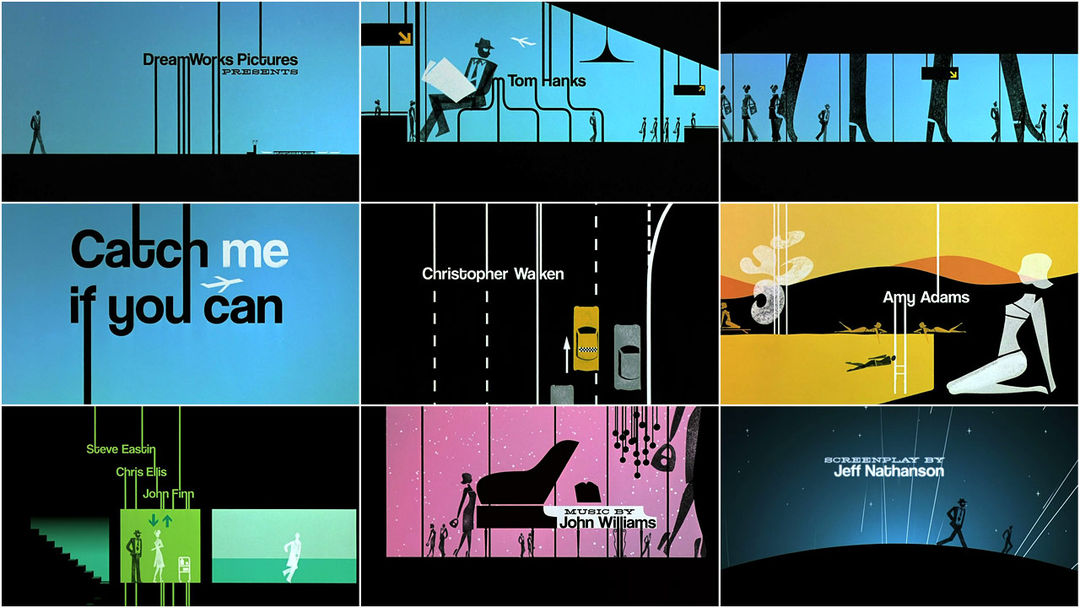
A few weeks ago, I watched the Steven Spielberg film Catch Me If You Can. I really enjoyed the film, but the thing that grabbed me right at the start was the title sequence. It is a very minimalistic animation that draws the viewer in and tells a story of its own. Just through silhouettes, it is able to capture the essence of the characters and tell their story. Even more impressive is the fact that the characters were not animated digitally. Rather, the creators made stamps of the characters and animated with those. There's a lot more detail on the process and other aspects of creating the titles in an interview on the Art of the Title page. Unfortunately I can't get the video to embed, but it is also available on the same page.