Showing posts with label avatar. Show all posts
Showing posts with label avatar. Show all posts
Wednesday, March 23, 2016
Why James Cameron waited to create Avatar
James Cameron's 2009 blockbuster hit, Avatar stepped over boundaries that had not been crossed in the cinema and CGI world ever before. Nominated for 9 Academy Awards, and winning 3, Avatar is also the #1 All Time Domestic movie ever, and the #1 All Time Worldwide movie. But what made this movie so different than any other, and why was it not done sooner? As a matter of fact, James Cameron wanted to release the movie in 1999 because he had the story complete, but did not have the proper technology to complete it until it was released in 2009. What convinced him that CGI effects had progressed enough is when he saw the motion-capture CGI animation that was done to Gollum in The Lord of the Rings. The movie is more than half CGI, and each frame of the CHI scenes took an average of 47 hours to render. When I was in London this past fall semester, I worked on a Sci-Fi list documentary where I was able to help find extensive facts about the movies that we were given and able to contact people to interview for the documentary. I researched Avatar extensively and was able to find out this amazing information plus so much more, and was astonished by the achievements and advancements that were made throughout the process and production of this movie. Here's a few of the videos I watched to learn more about Avatar.

Thursday, November 12, 2015
Performance Capture
Performance capture is a type of acting involving body sensors that track movement. Cameras at different angles record the movement in order to create a three-dimensional position of the character. The data is mapped on a digital model in 3D software, like Maya for example, so that the digital character moves like the recorded actor.
Below is a video featuring James Cameron and the performance technology used in Avatar.
Below is a video featuring James Cameron and the performance technology used in Avatar.
"We don't have to necessarily believe that they're 100% photo real and we don't necessarily have to believe that they actually exist--but we do have to believe them as emotional creatures," Cameron says on the Avatars in the film.
I find the head rig most interesting. It's a helmet like structure that fits comfortably on the head, along with a camera that captures the facial expression and performance.

I find the head rig most interesting. It's a helmet like structure that fits comfortably on the head, along with a camera that captures the facial expression and performance.
Thursday, September 17, 2015
Animation Favorites
So for my post this week I decided to share my favorite animated TV show and my favorite animated movie.
1) Fantastic Mr. Fox

_video_game_cover.jpg)
1) Fantastic Mr. Fox
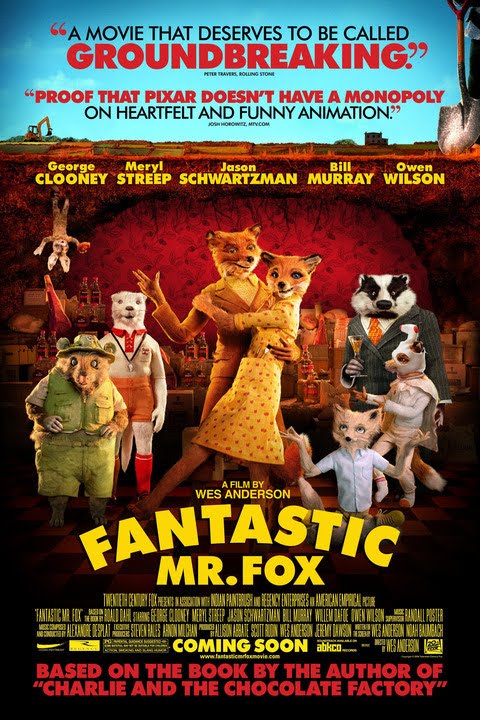
I know that this movie was in my post from last week, but I am posting about it again because I really love this movie. This is Wes Anderson's only animated movie so far, and he absolutely nailed it! This movie is so aesthetically amazing, as well as having a stellar cast and a great story. The animation in this movie is so wonderful. Every thing whether is be a tree, an animal, the hunters, a house, anything has its own energy in the film. Also the use of color in this film is brilliant, everything is so vibrant and beautiful. I also love that it is stop motion.
2) The Legend of Korra
Nickelodeon had a show called Avatar the Last Airbender which was a show in which people in this fictional version of the world could control elements through a force called "bending" each person can only control one element except for the Avatar who could control all four elements, and existed to bring harmony to the world. After the first show ended, Nickelodeon decided to reboot it. Korra is the new avatar to the same world, but with a new set of problems. This show is awesome because the animation involves people controlling fire, water, earth and air, so each of these elements has a different vibe so they need to move differently. The animators did a great job of making each element act differently. Fire was a lot of bursts and short quick movements, water was very smooth and fluid, air was light with a lot spirals and quick movements, and earth was a lot of levitating solid forms and pushing or pulling. I highly recommend this show to everyone.
Wednesday, February 25, 2015
Avatar and After Effects
Avatar was revolutionary in terms of 3-D animation and use of various digital effects. This video explores some of the post-production work involved in the process of putting the final cut together. I found it interesting that the video explains some of the terminology we have gone over in class such as rendering and the use of green screen. It's crazy to think that we are working on the same software that has been used to produce films grossing billions of dollars.
Friday, January 23, 2015
Avatar
Last month, the famous Nickelodeon series, Avatar, just concluded the fourth and final chapter of the Legend of Korra. It's amazing to think that an animated series that began in early 2005 consistently entertained so many viewers over the span of ten years. What's even more amazing to realize is that while the characters have changed throughout the series, the style of animation has remained the same. In elementary school, I remember rushing home to catch the latest episode of Avatar: The Last Airbender; a fictional series, based on modern martial arts, that highlights a group of friends who can "use the force" to move the world's elements: water, fire, air, and earth.

The color pallet utilized throughout the series, accompanied by the varying camera shots and object motion tracking draw the viewer into the animated world. Even though each of these characters are fictional, the accuracy of detail in the faces, skin tones, and emotional storyline invite the viewer to befriend Aang and his friends on their journey to save the world (Even the animals resemble real-life animals!).

It's also interesting to note that each of the voice actors for the series physically act out their lines to better interpret the scene and provide strong vocal emphasis to increase the realism of the cartoon. Even the direction of vision for the actor is identical to the cartoon (below). And it's interesting to note that this animation doesn't even incorporate motion capture.

Give it a watch; you'll enjoy it!
The color pallet utilized throughout the series, accompanied by the varying camera shots and object motion tracking draw the viewer into the animated world. Even though each of these characters are fictional, the accuracy of detail in the faces, skin tones, and emotional storyline invite the viewer to befriend Aang and his friends on their journey to save the world (Even the animals resemble real-life animals!).
It's also interesting to note that each of the voice actors for the series physically act out their lines to better interpret the scene and provide strong vocal emphasis to increase the realism of the cartoon. Even the direction of vision for the actor is identical to the cartoon (below). And it's interesting to note that this animation doesn't even incorporate motion capture.
Give it a watch; you'll enjoy it!
Friday, March 28, 2014
Animatrik Virtual Production
When most people think of virtual production, films such as Avatar and Transformers come to mind. Indeed, films such as these have helped to change the landscape of media and push forward ever evolving technologies. One company in particular that is at the forefront of such advancements is Animatrik Film Design, based out of Vancouver, British Columbia. The team at Animatrik has worked on films ranging from District 9 to The Lord of the Rings: The Return of the King. In addition to film, Animatrik has worked on video games such as Cyrsis 3 and Mortal Combat 9.
One of the ways that Animatrik has been able to carve out a niche in the media industry is by revolutionizing motion capturing techniques. Although it may be funny to see actors running around in skin-tight suits with motion sensing balls attached to them, these suits help to translate an actors real-life movements to a digital world. Thanks to modern technology, all the movements taking place are applied to the CG in real-time. Until recently, all of Animatrik motion capture work has taken place inside their Vancouver studio. However, thanks to the release of improved sensors which allow light to be emitted directly from a marker instead of from the camera, the studio has become more mobile and hopes it signals a new chapter in their growth.
Friday, March 21, 2014
5 Great Movies and Maya
This week, I was completely blown away and excited by Autodesk's program Maya. I have watched several different "behind-the-scenes" documentaries on several different films, and was able to watch as they created environments and creatures. For example, I loved watching how they made the creatures of the Lord of the Rings, and it is only now that I realized that they used the program Maya! I was so excited, and still am, to learn different aspects of Maya, even though there is so much depth and jobs involved in it. As I was researching I came across this article about 5 other movies that used Autodesk programs and the one thing they all had in common?: Maya.
The first was Inception, where they folded over the streets of Paris and had amazing settings.
Then there was Avatar, which was truly amazing with it's ability to combine live action 3D and CG effects. The actors of Avatar were so talented to be able to be on a virtually empty set and still perform as if they were in that actual environment.

Third on the list was Alice In Wonderland, which ties in my previous blog! Not only did they green screen most of the movie, but to find out that they used Maya as well really brought both concepts together in a way I never expected.
 Fourth, was Iron Man 2. This was really cool to read because they not only used Autodesk 3D programs, but also made parts of the suits in actual life around the actors. Then they molded the suits later in computer graphics.

Finally, and least expected, was Black Swan, when Natalie Portman turned into the swan.
Reading this article was eye-opening. There were a few that I suspected used Autodesk programs like Maya, but there were others that I never expected to find. After my brief experience, I can't imagine the amount of time it would take to do the things they accomplished in these films. It is truly incredible to continue to learn how "movie magic" is done.
By Amber Capogrossi
The first was Inception, where they folded over the streets of Paris and had amazing settings.
Then there was Avatar, which was truly amazing with it's ability to combine live action 3D and CG effects. The actors of Avatar were so talented to be able to be on a virtually empty set and still perform as if they were in that actual environment.


Finally, and least expected, was Black Swan, when Natalie Portman turned into the swan.
Reading this article was eye-opening. There were a few that I suspected used Autodesk programs like Maya, but there were others that I never expected to find. After my brief experience, I can't imagine the amount of time it would take to do the things they accomplished in these films. It is truly incredible to continue to learn how "movie magic" is done.
By Amber Capogrossi
Wednesday, February 12, 2014
Stickin' to What I Know
You guessed it! Rendering yet again. I don't know what it is about it, but I find it so fascinating. I think it's because of all of the computing power that goes into things like this. ANYWAY. I decided to make this post about the rendering related to James Cameron's Avatar.
Now I was looking through some articles and though I wasn't able to find how many frames were in the film, I was able to find how much storage was used to store the movie. While looking at the article, I found that it took 1 PETABYTE of storage. To put this into perspective, take 500 2 Terabyte drives and put them in a room... That's a Petabyte. Talk about huge. The place that rendered this is the same place that rendered King Kong and Lord of the Rings. You KNOW that this is a high class place when you hear those two movies in the same sentence.
Onto my favorite part of these articles: The computing power of these facilities. In the article it states that there are 34 racks of 32 machines. Doing some math that equates to 1088 machines. But going even deeper, there are about 40,000 processors and 104 Terabytes of RAM. TERABYTES OF RAM. That amount of ram is so much RAM, I can run 15 different video games, most likely 3 times over. Needless to say I couldn't even dream of that much RAM in a machine, let alone under one roof.
A small tid bit about this too: Cameron had a 300 million dollar budget according to this article. The storage alone for this movie would have been in the millions. That's just plain ridiculous.
If you want to read the article I got this info from, it's right here.

Now I was looking through some articles and though I wasn't able to find how many frames were in the film, I was able to find how much storage was used to store the movie. While looking at the article, I found that it took 1 PETABYTE of storage. To put this into perspective, take 500 2 Terabyte drives and put them in a room... That's a Petabyte. Talk about huge. The place that rendered this is the same place that rendered King Kong and Lord of the Rings. You KNOW that this is a high class place when you hear those two movies in the same sentence.
Onto my favorite part of these articles: The computing power of these facilities. In the article it states that there are 34 racks of 32 machines. Doing some math that equates to 1088 machines. But going even deeper, there are about 40,000 processors and 104 Terabytes of RAM. TERABYTES OF RAM. That amount of ram is so much RAM, I can run 15 different video games, most likely 3 times over. Needless to say I couldn't even dream of that much RAM in a machine, let alone under one roof.
A small tid bit about this too: Cameron had a 300 million dollar budget according to this article. The storage alone for this movie would have been in the millions. That's just plain ridiculous.
If you want to read the article I got this info from, it's right here.
Tuesday, September 10, 2013
Avatar: The Last Airbender Opening Sequence
Michael Dante DiMartino and Bryan Konietzko probably didn't go out to create one of the most critically acclaimed animations ever to grace the Nickelodeon station, but they did, and here we are.
Avatar: The Last Airbender is a feat of cultural references, storytelling, fantastic animation, drama, and comedy, all blended together in an easy-to-swallow package that will most like stick with generations of children and adults alike. The show appeals to its demographic (12 to 18 year olds) with the action-oriented fight scenes and the humor, but the story is thick enough to appeal to older viewers as well.
No matter what way you look at it, Avatar: The Last Airbender is a good show to spend your time watching. The quality of the animation is also top notch, and the opening animation from the very first episode definitely reflects that. Please note the animation style, reminiscent of eastern paintings, which the show draws a lot of its atmosphere from.
Friday, August 30, 2013
I may be super late to this party but over the summer for the first time I watch the Movie Avatar by written an directed by james cameron I originally wrote the film off as a block buster that i wouldn't be interested with too much cgi. but when i watched it i found my self happily surprised with the movie and even got a little teary eyed at certain points it was only after i was done watching the film that i realized i forgot that so much of the movie was basicly a cgi cartoon that really blew my mind because normally i can pick up on things like that. that movie came out almost 5 years ago its exciting to know that motion capture and animation technology has advanced beyond even that.
Saturday, March 31, 2012
Behind the Scenes of Avatar
So for the first ever, I saw Avatar this week and I was immediately amazed at the visual and special effects that were used throughout the entire film. I couldn't help but think of all the long exhausting process that it must have taken to make this idea a reality. Therefore after watching the movie, I went online and started looking for some behind the scenes videos and learning more about the hard work and time that it took to make this. The production of this film went above and beyond the simple use of a green screen and after effects. While I was on my search for videos I did come across this 22min behind the scenes video that covered everything from the casting of the characters to the various types of special cameras and technology that was used in the production process. If you have the time it is definitely a video worth watching, and I personally really enjoyed it and learned alot!!
ENJOY!
ENJOY!
Sunday, November 20, 2011
Peter Szewczyk - Dark Clouds

With quite the workload with movies the past few years, I was surprised to find out that Szewczyk had any time to work on anything else, but I did see that he posted on Vimeo a short film he did with visual effects entitled "Dark Clouds". It really is a remarkable piece, it's beautiful to look at and only about a minute and a half long. I will post the video below, but just in case it doesn't work, you can find the video here.
Dark Clouds | Short Film from Peter Szewczyk on Vimeo.
Saturday, September 24, 2011
Avatar
Avatar was a film that used programs like photoshop and after effects to create the most realistic fantasy world that was possible. The world of Pandora looks so real that when you're watching you don't even realize it is animated.
The way this film was made was different than most animated films. Instead of having the actors come in and read line and then have the animators create bodies for them James Cameron used motion capture to make the Avatars look as realistic as possible.
The way this film was made was different than most animated films. Instead of having the actors come in and read line and then have the animators create bodies for them James Cameron used motion capture to make the Avatars look as realistic as possible.
Friday, March 25, 2011
Reflections
Yesterday, while doing some green screen tutorial I mentioned the fact that when there are highly reflective surfaces, such as glass, involved, it is better to add that surface later via tracking and compositing, so that the glass surface reflects the final environment and not the studio where it was shot. Here is a perfect example from Avatar, thanks to Cinefex magazine, the premiere efx publication without a doubt. In this particular case a matching 3D model of the face shield was added later so that the actual story environment could be reflected. You can see the little red tracking dots around the face mask.

Friday, February 11, 2011
FX Studios
So I found this list of the 34 top FX studios. If you click on there names it will bring you to their websites where you can watch demo reels. In most of the reals they will show you before and after images and the stuff they do is absolutely amazing. These are the studios that did movies like Avatar, 2012, 300, and a bunch of other graphic heavy films.
Subscribe to:
Posts
(
Atom
)