To answer the question flat out, it's roughly 1.61803398875. But what does it mean, where does it come from, and most importantly, what does it do?
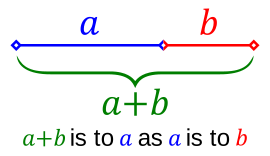
Well, the answer to these questions is something that everybody knows, just not consciously. The golden ratio can be found all throughout nature and art. Achieving the golden ratio can be as simple as a+b being to a as a is to b.
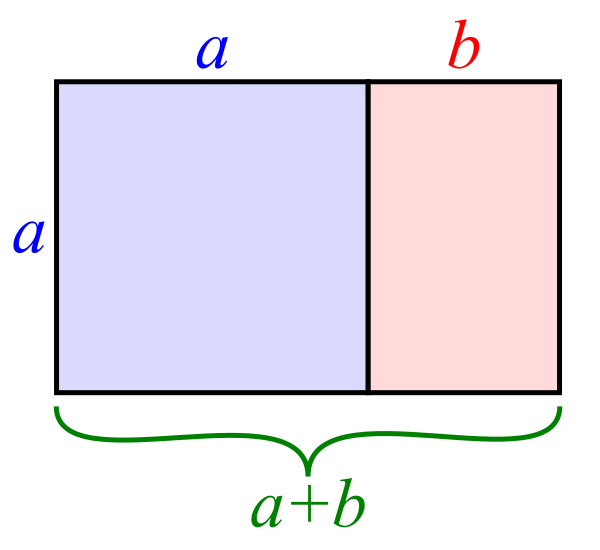
Does this rectangle look familiar? It's a perfect shape to draw or film things on.
The golden ratio can famously be found in plants, notably in their spirals which tend to result in Fibonacci numbers. (Golden ratio and Fiboncci are like, best buds)
This relationship would be a blog post in itself, but we got other stuff to go over. I encourage you all to head over to mathisfun.com to learn more!
The golden ratio pops up in art all the time. The more beautiful we tend to find things, the closer they are to the golden ratio. Take a look!
Remember, it's as simple as a+b is to a as a is to b
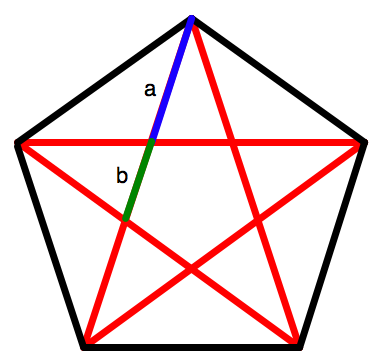
The golden ratio is found in things as simple as a pentagram,
95% of the time, I hate anything involved with math. Like most TVR majors, it's never really been my thing; and that's perfectly ok. I realize that almost everything I use in my day-to-day life involves math in one form or another, but I kind of just don't care. However, every once in a great while, I have to admit that math does something that really, truly impresses me. This is one of those moments.
A few weeks ago, Arturo talked about something called the Golden Ratio. I'd heard of it before, maybe in a middle school math class or something, but I decided to a little more research on it to see what I could find. I wasn't disappointed. In a nutshell, the ratio is based off of the Fibonacci Sequence (each number being the sum of the two numbers that come before it) where any two adjacent numbers in the sequence, if divided, form a ratio of 1.618. This ratio had been proven to be the most pleasing ration to the human eye. TVs used to come in a ratio of 16:10 (now they're most common in 16:9, which is still pretty close), as do credit cards, and even older iPhones and Ipod Touches. This isn't a coincidence.
What I find to be really strange, however, is how often this seemingly random pattern appears in nature. A great article on io9 points out how the Fibonacci sequence shows up on everything from flower petals to seashells to hurricane formations: even spiral galaxies, an unfathomable amount of distance away from Earth, have this shape, this ratio. It's unexplainable. If you search for this on YouTube, there'll be plenty of scientists and mathematicians trying to explain what's going here, but there will also be lots of crazy people trying to make some connections that just aren't there. It's crazy, and I just think it's so so cool.
So there you go. It doesn't have a whole lot to do with animation or motion graphics, and I understand it about as much as I understand how to use After Effects, but it's something to always keep in mind. If you want to make something look good; like, really good; use the magic, golden ratio. Everything else in the world does, so why shouldn't you.
Here's the link to one last article from the Guardian.