
Showing posts with label Math. Show all posts
Showing posts with label Math. Show all posts
Thursday, April 21, 2016
Processing
Arutro told me about a really interesting program that is worth exploring, especially if you have any interest or background in programming and computer science. The site describes the program as: "Processing is a flexible software sketchbook and a language for learning how to code within the context of the visual arts. Since 2001, Processing has promoted software literacy within the visual arts and visual literacy within technology." Basically it is a program that allows you to create art, motion graphics, among hundreds of other applications. The site contains a variety of examples of some of the basic uses. This is one that changes the hue as you drag your mouse across it. Below, you are given the code that makes it work, and it is often surprising how simple the basic stuff is. The language is based on java so if you are good with that program you should feel right at home. Download the program and try entering and tweaking some of the sample code if you are interested. It is a really cool concept and the possibilities are endless. Here are some exhibition examples of work people have done.


Tuesday, December 8, 2015
Visualizing Education Topics
I work as a TA for the Computer Science department and it is one of my favorite things that I do. But one of the big issues with helping students grasp CS topics is that it is hard to connect the lines of code on your screen to the actions that they represent.
One of the first ways I learned to cope with my understanding in these subjects was to draw pictures. Sometimes pictures drawn on a board or sheet of paper have limitations that animations can overcome. Modeling abstract or 3D concepts is the best way to visualize and learn.


This is a library of gifs featured on wiki pages that help explain mathematical concepts.

Computer science sorting algorithms visualized with audio representations for the process a computer takes when following different algorithms.

See math concepts modeled in animations that can be interacted with to help learn.
Wednesday, October 7, 2015
Math and Modeling
Math for Maya: I am really interested in math and computer science and getting to work with Maya was very exciting. A lot of my math courses involved modeling and working with surfaces and shapes in 3D space. I am really intrigued by the calculations and computations it takes to get Maya to work so smoothly. I wanted to research how the program worked.
I started with looking into the mathematics of NURBS (Non-Uniform Rational B-Splines). These are parameterized curves that are mathematically represented as either exact conics or piecewise polynomial curves. I was able to read about NURBS in the AutoDesk MAYA manual.
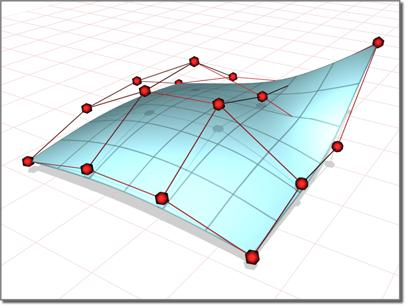 |
Non-uniform surface formed from control points and control polygons. |
Tool for Mathematicians:
In addition to finding that math that makes Maya happen, I found some videos of how Maya helps in mathematical visual representation. These are videos of intense and complex mathematical abstract sculptures.
Math for Artists:
It is helpful when creating graphics or models in 2D or 3D space to have a geometry memory refresh! This is an interesting tutorial about math in 3D modeling.
Thursday, September 18, 2014
The Golden Ratio - What is it?

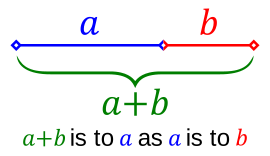
Well, the answer to these questions is something that everybody knows, just not consciously. The golden ratio can be found all throughout nature and art. Achieving the golden ratio can be as simple as a+b being to a as a is to b.
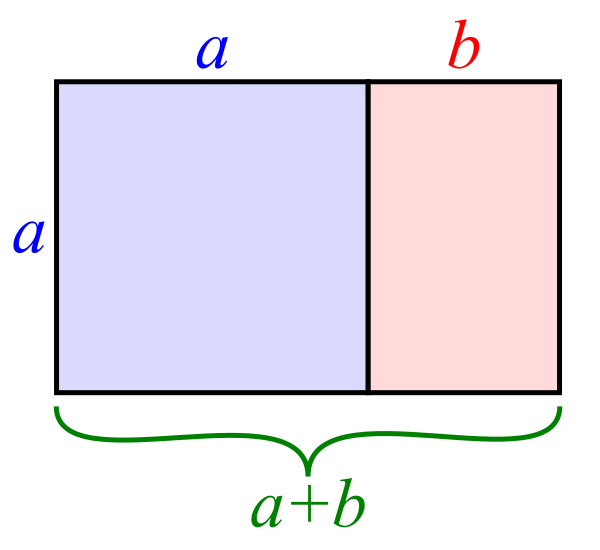
Does this rectangle look familiar? It's a perfect shape to draw or film things on.
The golden ratio can famously be found in plants, notably in their spirals which tend to result in Fibonacci numbers. (Golden ratio and Fiboncci are like, best buds)

This relationship would be a blog post in itself, but we got other stuff to go over. I encourage you all to head over to mathisfun.com to learn more!
The golden ratio pops up in art all the time. The more beautiful we tend to find things, the closer they are to the golden ratio. Take a look!

Remember, it's as simple as a+b is to a as a is to b
The golden ratio is found in things as simple as a pentagram,
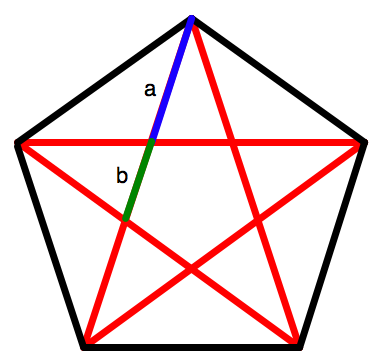
To things as complex as the human body.

Subscribe to:
Posts
(
Atom
)