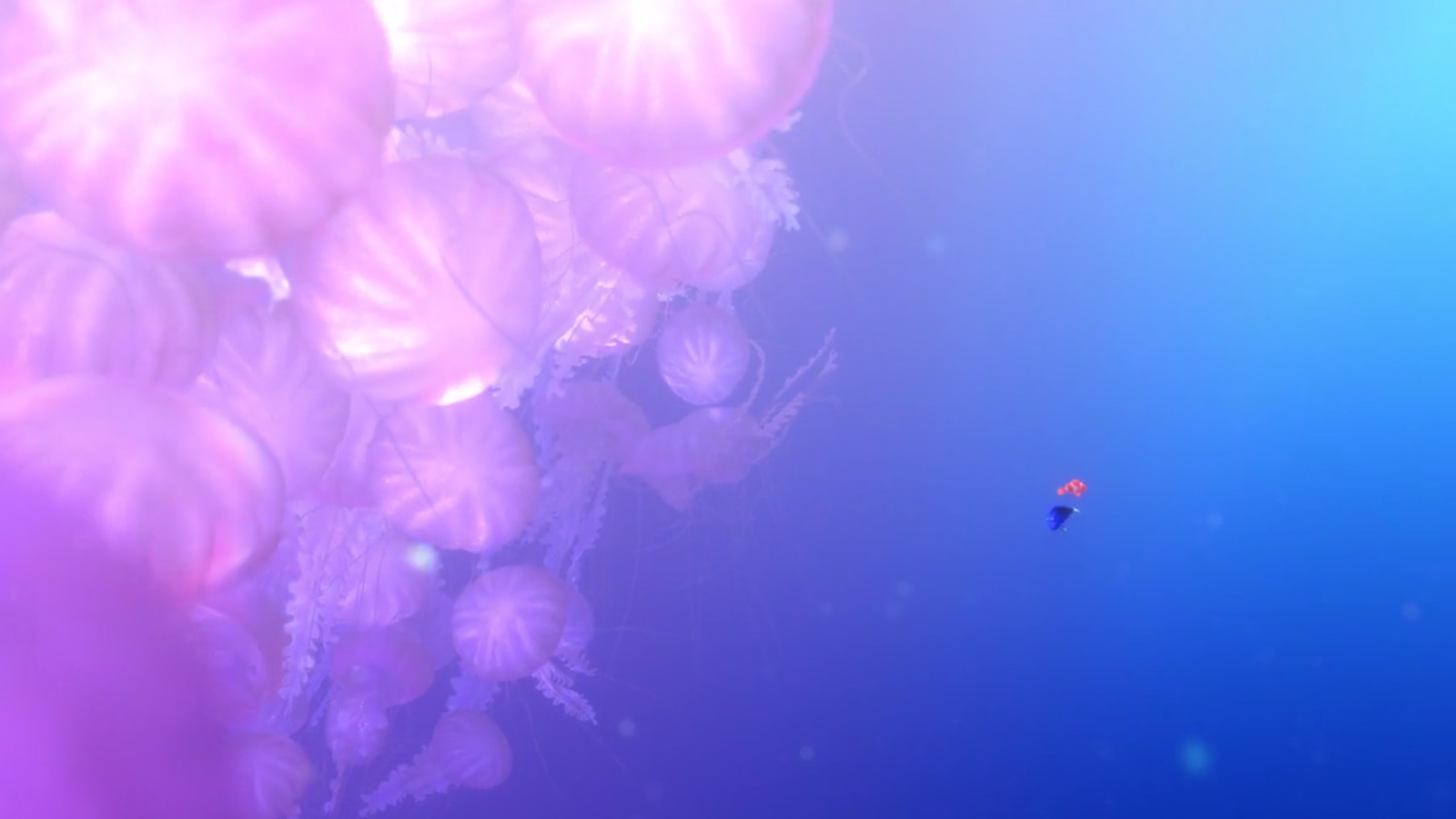
Home Sweet Home is an animated short film directed and created by French filmmakers Romain Mazevet, Pierre Clenet, and Alejandro Diaz. Winner of multiple awards in its 2013 debut, Home Sweet Home features the story of a house as it embarks from its desolate suburban location into a grand adventure across the world.
The most notable aspect of this short film are the visuals. It's opening scene makes it hard to tell if it's a work of animation or not. The environments vary tremendously and are always lush and full of life. The film definitely gives a Pixar feel through its animation and lively characters. The team working on this film implemented innovative ways to make a seemingly normal looking house full of life and character. Windows and doors are used for eyes and mouths and hedges and overgrown bushes are used for facial hair. Different kinds of houses, from dog houses to mobile homes, are used throughout the film and add a lot to the story and environment.
Overall, Home Sweet Home is the most original and charming animated short film I've seen in a while. Every minute of the ten minute feature is brimming with gorgeous visuals and creative ideas. You can check it out for yourself :
Home Sweet Home from Home sweet home the film on Vimeo.
Showing posts with label Pixar. Show all posts
Thursday, April 21, 2016
Home Sweet Home
Labels:
Alejandro Diaz
,
animated
,
france
,
Home Sweet Home
,
Pierre Clenet
,
Pixar
,
Romain Mazevet
,
short film
,
Supinfocom
Thursday, April 14, 2016
Lighting and Animation
I stumbled across an interesting Ted Talk about how lighting
plays a very crucial role within animation. In the Ted Talk, Danielle Feinberg
discusses her career at Pixar and how her work at Pixar has made her dream of having art as a career possible. She speaks in depth about how lighting has the potential to drastically change the feeling of
the film as well as bring a scene or character to life. Lighting is such an
important characteristic to not only cinema but animation as well and I suggest you
all take a peek at this Ted Talk, it is around 12 minutes but I promise it is
very interesting!
Tuesday, April 12, 2016
Professional Uses of After Effects
A lot of production companies and video game development companies design their own in-house software to accommodate their needs, such as Pixar. However, even these studios use publicly accessible software such as After Effects to do things we assume were made on far fancier software.
Here is a video from Adobe's site detailing the use of After Effects as a major editing tool for the movies Iron Man 3 and Oblivion. Its cool to see how within reach the professional level methods and motion graphics are, for those of us advancing our varying levels of motion graphics abilities. (Adobe has some other great videos relating to After Effects and their other products that are worth looking through.)
Labels:
adobe
,
Adobe TV
,
After Effects
,
animation
,
cinema
,
hollywood
,
in-house
,
Iron Man
,
motion graphics
,
Oblivion
,
Pixar
,
professional
,
public
,
tutorial
Thursday, March 24, 2016
I LAVA Pixar Shorts.
So you know how Pixar has those shorts to start off their films. So recently I was reintroduced to LAVA.(You know the short that started Inside Out.) You know, the one about the really cute song about the volcano that sings about how much he’d love to love someone someday! At first the animation style semi-realistic and it pans up to a very old weathered looking volcano. Each animal shown has it’s counterpart and the volcano man longs for this connection. He deserves someone to "lava" too! Anyways the story goes on and the short is very vibrant with color and just a beautiful short and I swear there won’t be a dry eye in the house!
UPDATE:
Unfortunately, and probably due to copyright issues, there is no full version of Lava That I can find online. However, I have found the full song in a lyric video that shows screen caps from the short film So feel free to take a listen.
UPDATE:
Unfortunately, and probably due to copyright issues, there is no full version of Lava That I can find online. However, I have found the full song in a lyric video that shows screen caps from the short film So feel free to take a listen.
Labels:
animation
,
inside out
,
LAVA
,
Pixar
,
Pixar Shorts
,
shorts
Thursday, March 3, 2016
Finding Out How To Render
Today I found out that I have been rendering wrong for a while. It may possibly be because I did not take notes that were extensive enough, but Arturo informed me today that I cannot render with the Animation setting and that H264 was a better option. I also found out that closing applications makes rendering go faster. These may seem like simple things to most people, but it was a great revelation for me and makes it easier on my part. I also learned just how long it takes to render an animation. For my name project only being 8 seconds long, it is incomprehensible to me how long a full length animated movie must take to render. For Pixar films, I found out that it can take anywhere up to 8 hours to render just one shot of the film. The time it takes to create animated films and the patience needed to render is impressive and admirable.
Labels:
After Effects
,
animation
,
applications
,
Films
,
h264
,
Pixar
,
render
,
rendering
,
shot
,
time
Monday, February 29, 2016
Boy and the World
Labels:
animation
,
globalization
,
Pixar
Thursday, February 25, 2016
Character Animation
I often find that a lot of my classes are connected in ways that aren't super obvious. Other than Motion Graphics & Animation, Program Development is the only other Park class I'm taking right now. In my class we come up with ideas for television shows, movies, documentaries, web shows, and many other types of visual media that can be sold. One of the fundamental elements to any story is character--people know this from a very young age. What I didn't realize was how much character affects every process in an animation.
This video gives a brief behind the scenes look at the making of the 2012 Pixar movie Brave. The narrator of this short video describes how every movement Merida makes reflects her character. I thought this was really interesting. I mean, it obviously makes sense but I guess when I'm watching the movie I'm so absorbed in the world that I'm not analyzing or thinking about things like that. I believe this is what makes an animated character seem so real and likable. The same goes for Anna in Disney Animation Studio's Frozen: Anna is energetic, quirky, and awkward so she does things like jumping on couches, stumbling around the castle she lives in, and accidentally throwing a bust into a cake. This part of an animated film is so essential and specific. A director can't rely on his actors to move like the characters, rather each movement has to be created. I guess my question is, whose job is that? Is it the responsibility of a person involved in the actual animating process, or someone involved in the writing process that works with an animator?
![]() |
| Oops |
Labels:
animated movement
,
animation
,
Brave
,
character
,
Frozen
,
Pixar
,
Walt Disney Animation Studios
Saturday, February 13, 2016
Traveling Pixar Exhibit
A few months ago I had the pleasure of going to the traveling Pixar Exhibit at the Museum of Science in Boston. These types of exhibits are very hands on and interactive. While it may have been a little more technical than the Harry Potter or Lord of the Rings traveling exhibits, as a film student take 3D and animation classes, it was awesome. Each station that was set up demonstrated some aspect of animation, whether it be lighting, hair, working in 3D space, etc. There were simplified versions of the programs we use such as Maya, Cinema 4D, After Effects and more, to help kids interact in similar ways as animators do, with their favorite Pixar characters. One example of these exhibits was a computer screen with various lighting options such as intensity, color, and more. When the options are changed, there was a small, physical scene that is affected by all these changes. The exhibit was awesome and felt like walking into a physical manifestation of my 3D animation class. I highly recommend the exhibit if it comes to a museum near you.
Here is some info
.
Zoetropes
Zoetropes are an awesome older form of animation we learned about in my animation class a few years ago. If you don't know, they are a circular device with each frame of an animated movement drawn around the circle. You then look through a viewing window and as the zoetrope spins, it appears to be moving. Here is an example of an older zoetrope. Zoetropes are a great physical example of all the frames of an animation, as well as the variety in the types of animation. Pixar designed an amazing and complex 3D zoetrope. It has traveled the world to places like England, Scotland, South Korea, Finland, and many more at various exhibitions. I would love to see one of these in person. Check out this video to see it and hear how it works:
Thursday, February 4, 2016
Amateur at After Effects.
This past
week I have been experiencing Adobe After Effects and I have to say it isn’t as
scary as I had originally though it would be. Although I have had friends and
classmates who have utilized After Effects within their projects, I never
though I would one day attempt to tackle this program myself.
After my
first official week of After Effects, I can say for myself that it is one hell
of a program that where you can do almost anything you set your mind to.
Granted, watching Video CoPilot tutorials has been a huge service to me and
has personally made After Effects more manageable to comprehend. Although I
still need the aid of tutorials I do honestly feel as if I am learning
something that will hopefully help me in the future of me career.
But enough
about me! I want to talk about one of my favorite animated shorts. Remember
that short about the older gentlemen that is in a very heated game of chess
with what seem to be his arch nemesis? Yeah Pixar’s “Geri’s Game” (yes, I had
to Google the title.) has been and is still one of my most favorite animated
shorts of all time. It’s just so comical and the twist at the end was just astounding.
So yeah, refresh your memory and take another look.
Labels:
Adobe After Effects
,
Geri's Game
,
Pixar
,
Pixar Shorts
,
short animation
,
video copilot
Thursday, January 28, 2016
Animation is impressive
Coming into this Motion Graphics and Animation class, I can confidently say I know nothing about animating. I've never used After Effects or Maya before, but I plan on being able to improve my skills throughout the next few months of the year. Animated movies have always been a very important part of my life, especially Pixar and Disney movies, and I have always found animators to be some of the most talented people. When I was in London, I had an internship at Objective Productions, where one part of it was finding facts about different animated movies, including Shrek, Frozen and Bambi. It was interesting to view the commentary on how they created Frozen, a very recent Disney film to how they animated Bambi, the first Disney film ever created. The content that I viewed showed me the evolution of cartoon animation and how everything used to be drawn by hand while now everything is digitally animated and it can take days just to animate a characters hair! Overall, animation is something that I really admire, and I am excited to become more knowledgeable on how to create certain things for all of the projects that we are going to do in class.
Here is the link to the Frozen documentary I watched:
And here is the documentary on Bambi I watched:
Labels:
After Effects
,
animation
,
bambi
,
Disney
,
Frozen
,
London
,
Maya
,
motion graphics
,
objective productions
,
Pixar
,
shrek
,
Walt Disney
Thursday, November 19, 2015
Finding Dory
So everyone knows or knows of Finding Nemo. A story about a lost little fish who get captured by a fisherman and put into a fish tank at 42 wallaby way Sydney Australia. His dad Marlin, must go on an adventure to find and rescue Nemo. Along the way, Marlin meets and unlikely friend named Dory, a blue fish with a short term memory problem. She lost her memory into all of our hearts and was one of the most memorable characters in the film. And coming next year, there is finally a film to do her justice. Finding Dory is coming out in 2016 and I could not be more amped! Ellen Degeneres is going to reprise her role as the funny, and heart warming fish. The film is sure to be hilarious and touching and I am going to see it the minute it comes out.
Labels:
Ellen DeGeneres
,
Finding Dory
,
Pixar
Thursday, October 15, 2015
The Good Dinosaur - Behind The Scenes
When making The Good Dinosaur, Pixar wanted to something completely different with their landscape shots. In a normal Pixar film, there is one big "establishing shot" of the landscape in the beginning, which can take months to create. Because of the time consuming process, the rest of the film is is set inside or in a more simple location.
However, the creators of The Good Dinosaur wanted to break away from this cycle and wanted an animated film shot with the complexity of the "establishing shot." They wanted the landscape to be realistic and very detailed, but there was no way to do the number of sequences featuring big landscape shots using Pixar's traditional process. The creators simply dud not have the time to design and render that much landscape, so they had to get creative.
The creators ended up using U.S Geological Survey, which posts a huge amount of topographical date to its website, such as the height about sea level of all of the land features and lots of satellite images. So they ended up downloading a lot of that data and put into their computer and then tried to "render" the real-life landscape. And it surprisingly worked! They were actually able to point a digital "camera" anywhere in a 360-degree rotation and get an image with this data.
They ended up downloading over 65,000 square miles of USGS data. And then added more detail to the landscapes, such as trees, vegetation, and rocks. They ended up using photoreference to build these details, rather than build it from scratch. In the end, the creators made the movie very realistic, with a "painterly realism" rather than photorealism. It is still pretty realistic and very well done.
The movie also took a lot of server space, between the landscape and nature effects, The Good Dinosaur," took up 300 TB of server space, which is ten times as much as Pixars' 2013 Monsters University.
To read more click here.
Labels:
Landscapes
,
Pixar
,
the good dinosaur
Thursday, October 8, 2015
The Good Dinosaur
I read a pretty cool article about the Good Dinosaur. If you have seen a trailer or know anything about the movie, the dinosaurs in it aren't your typical looking dinosaurs that you see in the textbook. A writer for the website sat down with the director and asked him why he made them the way that he did. The director said it has all to do with the theme of "What if?". So what if the dinosaurs aren't what we actually think that they look like? Yes we can tell from the bones and such but we don't know what their coloring was or what exactly they were like. This movie questions all of that. They also made the dinosaurs hillbilly type of characters. Because the dinosaurs now live among the humans, what if they became like farm animals or something like that? If you want to read more about the article you can access it here. Also here is the link to the trailer if you want to know more about the movie:
Labels:
#animation
,
#realistic #dinosaur
,
Human
,
Pixar
,
the good dinosaur
,
what if
Prep for my Title Project
With lest than 2 months to the release of The Good Dinosaur, I want to make my Title sequence for this film. There's plenty of information avalible about the film online, but I wanted to try my hand at making a short Title sequence for the film. I wanted to share some of my ideas and give an Idea of the style I'm going for:
Firstly, the Two Trailers:
The Trailers give the most amount of information out there, specifically the story. As I blogged about last week, this pixar piece has alot of work put into the terrain and landscape. With all the focus on the Water especially, I wanted to use a mixture of fluid dynamics and 2D shapes to move around the names of the title sequence.
Basing alot of the style on the title sequence from Monsters, Inc.,
my plan is to use basic shapes of ovals and circles to show the characters, and keep the piece almost flat.
I also Want to try making some Text flow away as if it's in a stream:
and I'm pretty sure I found a Tutorial for how to make it work in Maya Here:
Below is a list of all the references I'd like to include in my Title Sequence:
Firstly, the Two Trailers:
The Trailers give the most amount of information out there, specifically the story. As I blogged about last week, this pixar piece has alot of work put into the terrain and landscape. With all the focus on the Water especially, I wanted to use a mixture of fluid dynamics and 2D shapes to move around the names of the title sequence.
Basing alot of the style on the title sequence from Monsters, Inc.,
my plan is to use basic shapes of ovals and circles to show the characters, and keep the piece almost flat.
I also Want to try making some Text flow away as if it's in a stream:
and I'm pretty sure I found a Tutorial for how to make it work in Maya Here:
Below is a list of all the references I'd like to include in my Title Sequence:
- Fireflies
- Comet
- Arlo the Dinosaur
- Spot the Boy
- Raging Water
- Crystals
- rushing past Vast amounts of land and sky.
I'll keep you up to date on the rest of the project as I go.
Labels:
Fluid
,
fluid mechanics
,
fluid simulation
,
Maya
,
Monsters Inc.
,
Pixar
,
the good dinosaur
,
trailer
,
trailers
,
tutorial
Wednesday, September 30, 2015
The Good Dinosaur
Pixar Studio's newest feature film is arriving in theaters this Thanksgiving, and it will be the first pixar film to be released in the same year as another (ie. Inside Out) Pixar is also not slowing down. In 2016 we'll be getting Finding Dory, the sequel to Finding Nemo, followed by Toy Story 4 and the brand new property, Coco, in 2017.
Either way, Pixar is one to always push the envelope in terms of technical achievements. In Good Dinosaur, the focus was on Environmental Effects. For example:
![]() |
| A Look at foilage from Bug's Life (1998) |
| A rainy shot of procedurally placed foliage in The Good Dinosaur (2015) |
Also Water has seen a whole new breath of realism, using a new algorithm to calculate fluid mechanics. Notice how in Finding Nemo the Water looks to be made more of plastic that the more real photorealistic water from The Good Dinosaur:
| Marlin looks for his son in Finding Nemo (2003) |
| Arlo gets whisked away in photorealistic water in The Good Dinosaur (2015) |
Lastly,The film's settings are unlike anything seen in a Pixar movie until this point, with a focus on large and extremely accurate open areas. The film's environments were created using terrain mapping technology to capture the actual geometry of several areas found in the American wilderness and then using that data to recreate photorealistic landscapes for huge areal shots.
| The Terrain from Up (2009) |
| Procedurally Generated Terrain made for The Good Dinosaur (2015) |
With all the added hype surrounding this new feature, and the suggestion to work on title sequences for upcoming films I've decided to try creating a title sequence for The Good Dinosaur. I think creating a Title Sequence from scratch without having a preexisting idea of what the original looks like, I will have much more creative freedom to create my own!
Labels:
#environment
,
#realistic #dinosaur
,
1998
,
2003
,
2009
,
a bug's life
,
Arlo
,
finding nemo
,
fluid mechanics
,
fluid simulation
,
Pixar
,
procederal
,
procedural texturing
,
the good dinosaur
,
Up
Sunday, September 20, 2015
Pixar Supercut
Color theory is a big part of filmmaking. It allows the filmmaker to subtly convey a tone or feeling to the audience. Color theory is most commonly known for giving Hollywood blockbuster movies their dramatic undertones. Teal and orange is one of, if not the most, common color combinations that filmmakers utilize.
Red is danger, yellow is happiness, green is growth, blue is tranquility, and pink is friendship.
However, color theory is not reserved for live action films. Color plays a huge role in animated features. More often than not, it is an animator's job to give an inanimate object human-like expressions and emotions. It can be quite difficult to make, let's say, a robot look as though it is experiencing wonder. I recently stumbled upon this fantastic video that takes the most colorful scenes from Pixar movies and organizes them according to ROYGBIV, that is, the colors of the rainbow.
Here's the video I'm referencing: Pixar Supercut
If you know anything about color theory you'll be able to tell how each color affects each scene in the movie. For the still frames below, the emotion or state that the color represents is listed:
Labels:
blockbuster movie
,
color theory
,
Pixar
,
supercut
Thursday, September 10, 2015
Animating to Music
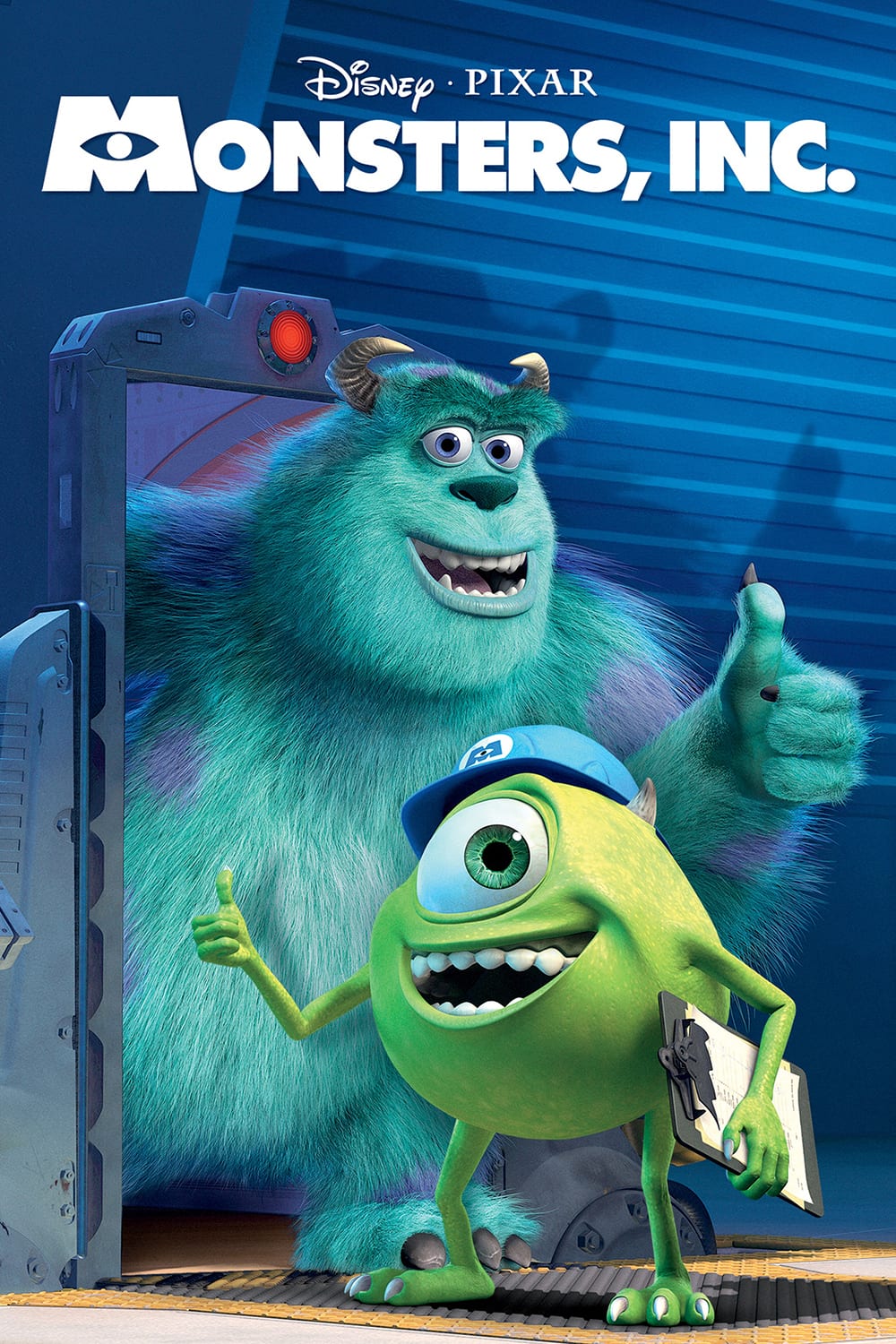
After using sound in collaboration with visuals on Wednesday, I was reminded of one of my favourite animated sequences from my childhood. The opening to Pixar's 2001 animated comedy, Monsters, Inc.
The opening cleverly features several animated doors (which play a prominent role in the film) dancing around, revealing title credits. All to one of Randy Newman's chirpy tunes from the soundtrack. The upbeat jazz instrumental provides a fun way of opening the film.
I really like how there's a nice balance between doors that move to the music, and ones that move independently. It can be dangerously easy to create a null which holds audio information, then go ahead and parent the hell out of every on screen object to the null. Sure, you'll have lots of moving pieces, but things can start to feel to mechanical and automated. The Monsters, Inc. opening has fluidity, while maintaining chirpiness and overall feeling in time with the music.
Check it out here, I think it's really fun.
Labels:
Fluid
,
Monsters Inc.
,
Music
,
Pixar
Wednesday, September 9, 2015
History of Pixar
Pixar Studio, originally a step child of Geourge Lucas has been popping up in conversations around me recently, so I decided I might look into the history of the creation of this animation studio.
Lucas Arts, an American film and television production company, was focused on innovative special effects since it was founded in 1971. Working on major motion pictures like Labyrinth (1986), Indiana Jones(1981), and the Star Wars Trilogy (1977-1983) Lucas film had a reputation as one of the most advanced special effects houses in all of Hollywood.
Lucas saw special effects as something to paint your films with. The technologies we had were the colors, and the effects were only the parts that added flourish to the story lines. Lucas had found himself always looking for ways to make his effects better, and cheaper.
Although Lucas was never "interested in computers" his company was one of the first to try using this new color in filmmaking.
At the time, in order to do any kind of digital image processing, you needed to find a way to get your image into the computer. Lucas was trying to solve the issue: "How do you get in and out of the Computer." digital Image processing was the promised land for filmmakers because not only would film scanned-in and manipulated in the computer be free from any generational loss (Negative Quality) but mistakes in the original photography (such as lighting on a blue-screen element that was inconsistent with its background plate) could be corrected without the costs and time delays of reshooting.
Lucas approached Ed Catmull in 1979 and asked him to head up a group to bring computer graphics, video editing, and digital audio into the entertainment field. With funds dwindling from Dick Shoup, a millionaire in New York (The majority of his money from starting the New York Institute of Technology) Catmull was looking for a way to incorporate, and continue research in 3D modeling. Remember at the time 3D was very basic, and thinks like texture mapping, lighting, and polygon manipulation were almost nonexistent. In 1979 Catmull became the Vice President at the seminal Industrial Light & Magic computer graphics division at Lucasfilm.
A few years later (1984) John Lasseter, also joined the Pixar team at LucasFilms after working on Tron (1982). 3D is a very expensive animation style, and at the time George Lucas was in the process of splitting funds with he recently divorced wife, so he was forced to cut funding to the Pixar group.
As Lucas's assets were being disseminated, Steve Jobs stepped in. Jobs had already turned down a position with the pixar team in 1984, and seized this opportunity to acquire the division instead. With new funding, Pixar found itself back on it's feet and became it's own company.
For more information, and a more in-depth timeline see: The Pixar Story
Lucas Arts, an American film and television production company, was focused on innovative special effects since it was founded in 1971. Working on major motion pictures like Labyrinth (1986), Indiana Jones(1981), and the Star Wars Trilogy (1977-1983) Lucas film had a reputation as one of the most advanced special effects houses in all of Hollywood.
Lucas saw special effects as something to paint your films with. The technologies we had were the colors, and the effects were only the parts that added flourish to the story lines. Lucas had found himself always looking for ways to make his effects better, and cheaper.
Although Lucas was never "interested in computers" his company was one of the first to try using this new color in filmmaking.
At the time, in order to do any kind of digital image processing, you needed to find a way to get your image into the computer. Lucas was trying to solve the issue: "How do you get in and out of the Computer." digital Image processing was the promised land for filmmakers because not only would film scanned-in and manipulated in the computer be free from any generational loss (Negative Quality) but mistakes in the original photography (such as lighting on a blue-screen element that was inconsistent with its background plate) could be corrected without the costs and time delays of reshooting.
Lucas approached Ed Catmull in 1979 and asked him to head up a group to bring computer graphics, video editing, and digital audio into the entertainment field. With funds dwindling from Dick Shoup, a millionaire in New York (The majority of his money from starting the New York Institute of Technology) Catmull was looking for a way to incorporate, and continue research in 3D modeling. Remember at the time 3D was very basic, and thinks like texture mapping, lighting, and polygon manipulation were almost nonexistent. In 1979 Catmull became the Vice President at the seminal Industrial Light & Magic computer graphics division at Lucasfilm.
A few years later (1984) John Lasseter, also joined the Pixar team at LucasFilms after working on Tron (1982). 3D is a very expensive animation style, and at the time George Lucas was in the process of splitting funds with he recently divorced wife, so he was forced to cut funding to the Pixar group.
As Lucas's assets were being disseminated, Steve Jobs stepped in. Jobs had already turned down a position with the pixar team in 1984, and seized this opportunity to acquire the division instead. With new funding, Pixar found itself back on it's feet and became it's own company.
For more information, and a more in-depth timeline see: The Pixar Story
Labels:
3D
,
animation history
,
Ed Catmull
,
george lucas
,
History
,
ILM
,
Indiana Jones
,
John Lasseter
,
Lucasfilm
,
Pixar
,
Special effects
,
Star Wars
Monday, September 7, 2015
Education and Animation
I was absolutely elated to see this article from KQED about Pixar using animation to teach about math and computer science. I would like to have a career in E-Learning, specifically working on projects that teach those subjects. I often say that my dream job would be to work for Khan Academy and now Pixar and Khan Academy have created a partnership. I love that article explained that these new lessons offered through Pixar are featuring jobs that the kids have possibly never even heard of. There are so many elements of media production and design that everyone could find an element that interests them. I had never considered E-Learning as a career until half-way through college because I had never really heard about it or understood how much went into producing it.
The lessons include:
Environmental Modeling
- modeling grass with parabolas
- calculating parabolas
Character Modeling
- modeling with subdivisions
- mathematics of subdivision
Animation
- intro to animation curves
- mathematics of animation curves
Crowds
- building crowds
- counting crowds
Sets and Staging
- geometric transformations
- mathematics of rotation
Rendering
- rendering 101
- mathematics of rendering
![]() |
| CLICK TO TAKE THE LESSONS |
Labels:
animation
,
career
,
carrie lindeman
,
e-learning
,
education
,
elearning
,
khan academy
,
KQED
,
math education
,
Pixar
Subscribe to:
Posts
(
Atom
)