Paperman is an Oscar Winning Disney short, directed by John Kahrs.
The story of animation is both charming and heartwarming, however it is the thought behind the animations that makes this short interesting.
Arriving at Disney, Khars talks about his appreciation for the hand drawings that go into the brainstorming of animations. He points out the "expressive" marks and the "simplicity" of the drawings that make these drawings unique.
This inspired Khars to try and find a way to incorporate the drawings from the preproduction of Paperman into the CG effects that would later become the animation. CG and photorealistic animations seemed to make up the majority of content being produced nowadays. Kahrs tried to imagine an animation that could be different. Paper man carries the drawings along with the CG effects, to create a beautiful and refreshingly different film.
My background in After Effects? At this point, slim. My experience with animation? Unless you count the endless hours spent watching and rewatching Pixar's Classics as a child--not extensive.
I open with this statement, not to demean myself, but to express my excitement in the journey ahead. I'm already impressed (and admittedly a bit overwhelmed) with some of the intricate and interesting posts of my peers. I hope to learn a lot from you in the coming weeks.
So what do I know about animation? The first time I recall watching an animated piece from a analytical perspective was in high school. We'd been discussing the basic elements of production--specifically related to short film--in a media class I was taking, when one afternoon my teacher began class with this:
(This is just the trailer)
Now, I assume many of you have seen Paperman. At the time, it was a fairly new piece and most people in my class were not familiar with it. I can still hear the collective "awe" we each sighed as the credits began to role. Even the toughest of stereotypical high school boys couldn't hide their enjoyment.
As I pondered what I might write about in this first post, I came across a list (found here) of the top animated shorts that "define Disney's success." As a friendly reminder of that day back in Mr. Zayatz's class, I was pleased to see Paperman ranked at #1. Having been in the back of my mind already, I figured that was enough a sign to write about it. Not only did Paperman win an Oscar in 2012, but it was also the first Disney animated short to win an Academy Award in 43 years.
What is it about this piece that people can't resist? It's storyline is simple, yes. And yet the animation, combined with incredible sound composition, takes the viewer on a romantic journey--dialogue not even needed! I think animation in general has a way of stretching the parameters of film. And that's why I'm so excited to explore all this class has to offer.
Friday, April 18, 2014
Paperman
Here is a short Disney Animation Studios
made in 2012. It is meant to be in 3D, but this will suffice. The
story, so simple, is told beautifully with amazing animation. It was
directed by John Kahrs,
who is also known for his work on some of Disney's most popular films
including Frozen, Monster's Inc., Wreck It Ralph, to name a few.
Here's the director, talking about the inspiration of the short.
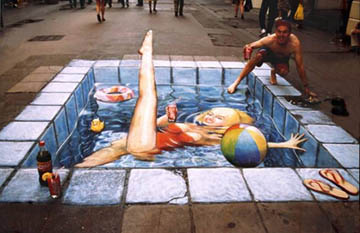
One of the neatest tricks in art is something called Forced Perspective, which can make things look 3 dimensional, even though they are only 2 dimensional drawings. Things like the picture below:
For more information on drawings and paintings like this, talk to Arturo, he's done some impressive stuff with it, some even involving toilet paper!
So, you can make 2D art look 3D, that's pretty impressive! But what about 3D art? Things like animation, can you make those look 2D? Well, in a way, you can!
Disney's short Paperman used a style of CG that was reminiscent of a painting or ink drawing. The short went on to win both an Annie and an Oscar, and is a visual treat. But as interesting as the short itself is, the way it was made is in my opinion, definitely worth a watch:
Recently, Pixar has released info on it's new artist friendly rendering system that captures the look of traditional watercolor. The new technique involves painting over some of the CG frames, and even works on the studio's previous animated works.
Screenshots from "Up" with the new system
The painted style looks interesting in motion, however, footage of the system in action is not on youtube, and I cannot upload it. I cannot stress how much it's really worth seeing, and can be seen easily be following this link
Keep in mind, Pixar's new system only effects rendering, not the animation itself. The animation is already done when the system is utilized, at least so for. This is much more an achievement in rendering than it is animation, but it brings new possibilities to the final look and feel of future CG animated features. I have no doubt we will be seeing this new system in the future, likely in an animated short. Keep an eye out for it!
With technology growing and improving so rapidly, sometimes we forget about the beauty of a simple product. There is always something so natural and easy about taking old techniques to create a modern piece or media. In this case, I am talking about taking a few steps backwards from the new and accepted forms of animation and motion graphics that are done on computers. When animation first became known, it was created through hand drawings. You had to pick up a pencil and draw your animation line by line.
I came across this video on YouTube about the creation and production of Paperman. If you have not seen Paperman, I definitely recommend you check it out. It's a simple love story about two busy city-goers who experience that magical "love-at-first-sight" feeling, with a piece of paper being used to connect them.
What I found interesting is how the creators of Paperman combined old and modern techniques of animation. It is said in the beginning of the video that there is nothing like hand drawn animation. Hand drawn characters have a certain details that are hard to put into words. The hand drawn story can tell such great emotion with such simplicity that director John Kahrs admires so much. He wanted to get those drawings on top of the CG. He wanted to keep the beautiful hand drawn sketches. So, that's exactly what they did. Paperman started as sketches of hand-drawn figures, just like some of the earliest classical Disney movies.
But what was so lovely and unique is how they took these hand-sketched characters and brought them to life with more modern day animating software and techniques. They put these drawings into programs and played with the rigging, shading, modeling, vector renderings, and much more to really bring these animated characters to life.
I really recommend that you take a look at this video. It goes through some of the really cool software and program effects that helped create the characters to look a certain way. Who would have thought that even with all of the technology we have, Paperman started out on paper....
This past Oscar's, Paperman won for best animated short film. Paperman was created by combining 2D classically drawn animation along with CGI 3D animation. The program used to do this is called "Meander" created by Eric Daniels. The drawings of these characters in Paperman were so amazing, they decided it was a waste to not try to animate them and combine it with the CGI. Paperman takes place in Manhattan in 1940 and is in black and white. Currently, 2D animation isn't as popular as it used to be because of the technology advances of 3D CGI. Hopefully in the future they will take this technique of combining 2D and 3D. This type of animation is very nostalgic since it reminds me of all the 50's disney movies I loved so much.