Pixar Studio's newest feature film is arriving in theaters this Thanksgiving, and it will be the first pixar film to be released in the same year as another (ie. Inside Out) Pixar is also not slowing down. In 2016 we'll be getting Finding Dory, the sequel to Finding Nemo, followed by Toy Story 4 and the brand new property, Coco, in 2017.
Either way, Pixar is one to always push the envelope in terms of technical achievements. In Good Dinosaur, the focus was on Environmental Effects. For example:
A Look at foilage from Bug's Life (1998)
A rainy shot of procedurally placed foliage in The Good Dinosaur (2015)
Also Water has seen a whole new breath of realism, using a new algorithm to calculate fluid mechanics. Notice how in Finding Nemo the Water looks to be made more of plastic that the more real photorealistic water from The Good Dinosaur:
Marlin looks for his son in Finding Nemo (2003)
Arlo gets whisked away in photorealistic water in The Good Dinosaur (2015)
Lastly,The film's settings are unlike anything seen in a Pixar movie until this point, with a focus on large and extremely accurate open areas. The film's environments were created using terrain mapping technology to capture the actual geometry of several areas found in the American wilderness and then using that data to recreate photorealistic landscapes for huge areal shots.
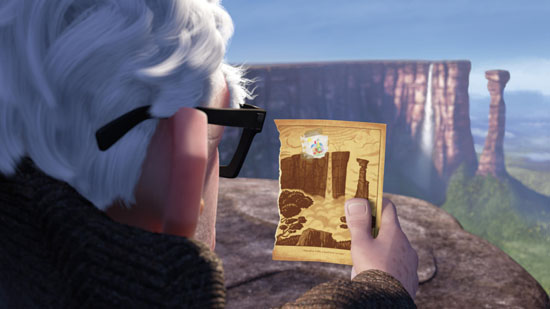
The Terrain from Up (2009)
Procedurally Generated Terrain made for The Good Dinosaur (2015)
With all the added hype surrounding this new feature, and the suggestion to work on title sequences for upcoming films I've decided to try creating a title sequence for The Good Dinosaur. I think creating a Title Sequence from scratch without having a preexisting idea of what the original looks like, I will have much more creative freedom to create my own!
It's been widely rumored for years the all the Pixar movies are actually in the same universe, but at different points in time. Pretty awesome, right? So let's get started!
The first film in the theory is none other than Brave. Brave introduces us to Merida, a red-haired princess in the Dark Ages of Scotland who tries to change her fate with the help of a witch. The witch helps Merida change her fate by turning her mother into a bear. What help that is. It's easy to believe that the witch had practiced turning humans into animals starting with Mor'du, the villain in Brave.
It's important to note that this theory is based off three groups all fighting for control and power: humans, animals, and machines. We see animals coming to their rise over the next three films, Finding Nemo, Ratatouille and Up.
Finding Nemo is about a clownfish that is able to swim across the ocean and back in search of his son, Nemo. What makes this so important is that he saves his son from humans.
In Ratatouille, Remy is an amazing chef, a job that only humans have. He actually does his cooking by controlling a human. Humans are also starting to see that animals are a lot smarter than they first thought. Also, Remy's ability is so incredible that word of his skill travels all the way to Charles Muntz, the villain in Up.
Charles Muntz, in his search for a rare type of bird (you would know it as Kevin), takes what he knows about Remy and invents dog collars that can let dogs speak with humans. We're also introduced to BnL, or Buy n' Large, the company that tries to buy Carl's house in the beginning of the movie (it's also the company that makes batteries for Buzz Lightyear).
That'll do it for this part. If you're interested in this theory, you can check out these two great videos that sum up the entire theory by SuperCarlinBrothers and Bloop Animation.
I'm sure that this has been mentioned somewhere on the blog before. Who doesn't love to find easter eggs in movies? Pixar has gotten into the habit of leaving hidden goodies in their films, to the point where I found a 10 minute long video of a collective list of them.
Like I said in my last post, I love when the extra effort is put in for viewers to explore and connect the different movies. I didn't realize how many of them that there actually were until I watched this video. Some of them may even be a bit far fetched (or very far fetched) but that's the fun of it. It also makes me want to go back and watch older films such as A Bug's Life. After just having watched Finding Nemo in another earlier class today, I definitely want to refresh my memory with all of the magic that Pixar has created over the years.
Because all of my post have been amazing I really just wanted to go out with a bang. So I figured I would share my top five favorite animation stuff. These can range from movies to clips. Lets get ready to rumble!!
5
Paperman (styled as paperman) is a 2012 black-and-white 3D hand-drawn/computer animatedromantic comedy short film produced by Walt Disney Animation Studios and directed by John Kahrs. The short blends traditional animation and computer animation.
4
Wreck-It Ralph is a 2012 American computer-animated family-comedy film[4] produced byWalt Disney Animation Studios and released by Walt Disney Pictures.[5] It is the 52nd animated feature in the Walt Disney Animated Classics series.
3
Up is a 2009 American 3D computer-animated comedy-adventure film produced by Pixar Animation Studios and released by Walt Disney Pictures. By tying thousands of balloons to his home, 78-year-old Carl sets out to fulfill his lifelong dream to see the wilds of South America and to complete a promise made to his lifelong love.
2
Tangled is a 2010 American computer animated musical fantasy-comedy film produced byWalt Disney Animation Studios and released by Walt Disney Pictures. Loosely based on theGerman fairy tale "Rapunzel" in the collection of folk tales published by the Brothers Grimm, it is the 50th animated feature in the Walt Disney Animated Classics series.
1
I honestly could not pick which of the Toy Story movies I liked best so I picked all of them! Toy Story is a CGI animated film series and Disney media franchise that began with the original 1995 film, Toy Story, produced by Pixar and distributed by Walt Disney Pictures. The franchise focuses on a group of toys that secretly come to life and end up unexpectedly embarking on life-changing adventures.
This week I was in desperate need of inspiration for our title sequence projects. I'm going to get a bit nostalgic on you because I immediately thought of my favorite title sequence I absolutely loved as a child growing up. It was the title sequence from 101 Dalmatians:
I love this sequence because it is absolutely fun and thrilling to watch. As a child, there were not very many interesting title sequences and more often than not, we would end up fast-forwarding through them. Yet, I ALWAYS watched this specific title sequence because I never knew what was going to come next. I vividly remember dancing to it even when I was little because even the music is fantastic.
Upon watching it again, I was shocked to realize that I recognized several techniques that we have already learned in class! For example, the spot revealing or erasing the words or even the spots pulsating to the music. I was thrilled to find out that my favorite sequence as a kid, I actually understood now as a college student!
I kept thinking of other sequences that I enjoyed. Here is another one from Tangled, though I believe it is the ending credits:
I think what is great about this title sequence is that we can see more of the story being told. Aspects of character development and fun story moments that weren't necessarily in the feature are seen. I think this is the hardest part for title sequences or ending credits: making them interesting and entertaining enough to hold peoples interest. I'm always happily surprised when I find I have sat through one and thoroughly enjoyed it.
Another one that I really, really enjoyed, that is not an animation, isfrom Sherlock Holmes.
I love the style and the feel of this sequence. It is not only interesting, but it fits with the period of the film with the images changing to what looks like drawings on old parchment. Here we see the story revealed, but in a increasingly interesting way. I came across this tutorial on how it was made by AgezMedia on youtube when I first looked for this video:
I didn't get through all of it yet, and it is very advanced, but it was incredibly fascinating to learn.
After looking into all of these, I think I'm ready to give my title sequence a try. It will be a challenge to make something intriguing, unique and entertaining, but if these examples can do it, I'm sure I can too.
Here are some student examples that I came across during my search on youtube. They are all for Pixar's film UP.
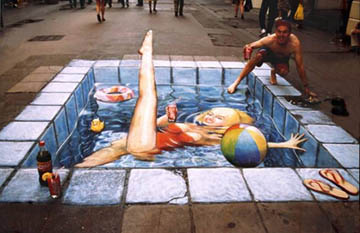
One of the neatest tricks in art is something called Forced Perspective, which can make things look 3 dimensional, even though they are only 2 dimensional drawings. Things like the picture below:
For more information on drawings and paintings like this, talk to Arturo, he's done some impressive stuff with it, some even involving toilet paper!
So, you can make 2D art look 3D, that's pretty impressive! But what about 3D art? Things like animation, can you make those look 2D? Well, in a way, you can!
Disney's short Paperman used a style of CG that was reminiscent of a painting or ink drawing. The short went on to win both an Annie and an Oscar, and is a visual treat. But as interesting as the short itself is, the way it was made is in my opinion, definitely worth a watch:
Recently, Pixar has released info on it's new artist friendly rendering system that captures the look of traditional watercolor. The new technique involves painting over some of the CG frames, and even works on the studio's previous animated works.
Screenshots from "Up" with the new system
The painted style looks interesting in motion, however, footage of the system in action is not on youtube, and I cannot upload it. I cannot stress how much it's really worth seeing, and can be seen easily be following this link
Keep in mind, Pixar's new system only effects rendering, not the animation itself. The animation is already done when the system is utilized, at least so for. This is much more an achievement in rendering than it is animation, but it brings new possibilities to the final look and feel of future CG animated features. I have no doubt we will be seeing this new system in the future, likely in an animated short. Keep an eye out for it!
Friday, May 3, 2013
DRAW MY LIFE - Zach King
I really enjoyed this video. I have seen many other videos from this user, but I though this one was cool for a few reasons. To start, he talks about his life an how he got into making all of his videos and his inspiration. The other part that makes this really cool, is the animation that he does. The theme is that of a pop-up book with all the animations drawn. He brings this into a whole other realm by having them interact in 3D space. When you look closely, you can see points that he made on both the horizontal and vertical planes for tracking purposes. On the horizontal paper, there are “x”s and on the chairs, there are pieces of blue tape. I assume these are tracking points because they are out of place and I have seen him use this type of method before. Over all, the video is quite inspirational and well done. I would also like to thank you Arturo for a great semester. I learned a Lot in this class, so thank you!
Lately I have focused my attention to the job market for after my departure from school. Past classes in the Park School have required me to Produce, Direct, Edit, and Film short films. Taking this class has made me investigate the roles of Producers and Directors for animated projects. Although its still a movie, the direction and leadership required of some of these roles is quite different when working completely digitally. I found this cool video of Brad Bird a director at Pixar. His work includes Brave, Toy Story 3, and UP. He also has past work on the Simpsons. Its pretty interesting to hear about his management style and he has some good advice for future professionals.
Check out this clip (embedding is not allowed): Pixar
I found this short film, Alma, that is directed by Rodrigo Bass. After 10 years in the animation field, this is the first film that Bass has directed. The one thing that stands out in this short is the incredible attention to detail. In the beginning, the detail in the cobble stone alley is very realistic, with snow separating each stone with slightly varying color and shape. From all angles, we see individual hairs of our main character, Alma. The tiling of the floor is like a mosaic, with each piece a unique shape and size. I was very impressed with the detail in this short film and felt like Bass took the time to to make sure every element in this short was just right. A painstaking process? I should think so. Notice at the end of the short the number of people listed in the credits for this 5:25 length piece.
Rodrigo Blass (or Rodrigo Blass Nacle) has worked on various well known animation films including Finding Nemo, Ratatouille, WALL-E, The Incredibles, and Up.