
Showing posts with label Steven Spielberg. Show all posts
Showing posts with label Steven Spielberg. Show all posts
Tuesday, September 1, 2015
A Journey to the Center of Procrastination : YouTube and Historical Rap Battles
Much like I had mentioned on my previous post, I am a busy college student. Very busy. By that, I mean that I peruse YouTube and completely ignore most if not all of my responsibilities as a student and as a functioning human being in today's fast-moving society. Anyway, what I'm getting at is Epic Rap Battles of History. Due to the fact that I'm genuinely a child, I get an incredible amount of entertainment out of these videos. Often laced with more offensive material than an internet troll could muster, ERB is usually rather educational and incredibly pleasing to the eye. Or not. There's really no in between. One of my favourites was a finale episode where they pit five monumental directors against each other in the form of, you guessed it, a rap battle. Honestly, why not. Warning: it's very NSFW with its profane lyrics. Sorry. Not really. It is a good watch, though.
 One of my favorite parts of these videos are the loads and loads of behind the scenes that they upload alongside the main photos. These videos usually showcase anything from the recording process, the post production, the costumes, and even just a full dance cover version. I enjoy seeing how much effort goes into the backgrounds because they tend to build them from scratch and usually use the same small things over and over but in different ways so the normal viewer wouldn't notice. Overall, I find it a very unique idea and really inspiring and I love learning their little shortcuts and reasonings when creating all of the aspects of their project. I wouldn't wanna work on it myself (I actually really would), but it is very nice to see all of the steps that go into creating the special effects and backgrounds for these videos.

Friday, November 28, 2014
Jurassic Park: The Making Of
With the recently released trailer for the newest addition to the Jurassic park saga, Jurassic World, I was inspired to revisit the origins of this series with the original movie and how it was made. Produced by Amblin Entertainment, Kathleen Kennedy, and Gerald Molen, Jurassic Park is what I consider to be one of Steven Spielberg’s best directed films. It’s weird to think that a film that I was absolutely obsessed with (and mildly terrified of) came out over twenty years ago. And taking the time to re-experience it, I have to say that it is a film that has certainly withstood the test of time. Especially considering the quality of their special effects, their rigs, and their innovative approach to putting dinosaurs onto the big screen.
At this point, if you’ve ever been interested in how they brought these ancient creatures to life, you might have heard everything from animatronics to green screens. And the fascinating thing about Jurassic Park is it utilized a combination of everything from giant malfunctioning T-Rex robots, to animated raptors, to green-screened sections of the actors staring up at nothing (while pretending they're experiencing what is the possibly one of the most extraordinary things a human can hope to witness).
Taking the time to at least browse through how they handled different situations (which I personally suggest watching the T-Rex animatronic), is a great way to inspire new and creative ways to approach projects of our own. If anything, it's definitely something that's worth watching just for the pure joy of knowing how they made such an iconic film.
Taking the time to at least browse through how they handled different situations (which I personally suggest watching the T-Rex animatronic), is a great way to inspire new and creative ways to approach projects of our own. If anything, it's definitely something that's worth watching just for the pure joy of knowing how they made such an iconic film.
Friday, May 3, 2013
TItle Sequence: Catch Me If You Can
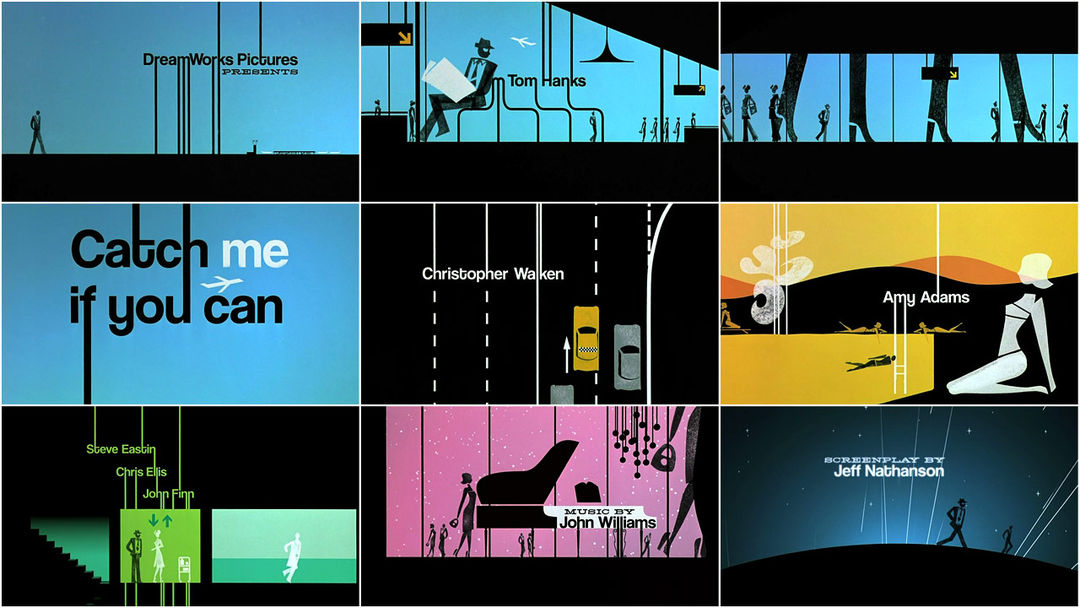
A few weeks ago, I watched the Steven Spielberg film Catch Me If You Can. I really enjoyed the film, but the thing that grabbed me right at the start was the title sequence. It is a very minimalistic animation that draws the viewer in and tells a story of its own. Just through silhouettes, it is able to capture the essence of the characters and tell their story. Even more impressive is the fact that the characters were not animated digitally. Rather, the creators made stamps of the characters and animated with those. There's a lot more detail on the process and other aspects of creating the titles in an interview on the Art of the Title page. Unfortunately I can't get the video to embed, but it is also available on the same page.
Thursday, March 21, 2013
Catch Me If You Can
I absolutely love this title sequence for Steven Spielberg's "Catch Me If You Can" (2002). I think it does a fantastic job at setting the stage for this great cat and mouse crime thriller. It also does a great job at introducing the amazing score by John Williams. This might be a stretch, but the animation reminds me a little bit of the hand animations of Norman McLaren. The way in which the lines interact with the pacing of the music is a lot like the way objects interact with the music in McLaren films.
Sunday, November 6, 2011
Jurassic Park
When I was little, my cousin used to be obsessed with dinosaurs, just like almost every other child. But when we would watch Jurassic Park, I would be scared to death thinking that the T-Rex used in the movie would break out from Hollywood's captivity center and come raging through my neighborhood. That's when my father had to explain to me that the dinosaurs used in the movies were not actually real, but instead animated robots with computer created effects.
Well 15 years later, and I'm learning the basic process of how these dinosaurs were created. The amount of work that goes into every scene with these creatures amazes me still, and I believe that with the technology available at that time, Jurassic Park is a beautiful example of how visual effects can make a movie. The team responsible is ILM, Industrial Light & Magic, who are known for working on many of the films we consider classic today, such as Raider's of the Lost Ark, E.T., and The Empire Strikes Back. In this article you can see some of the behind-the-scenes work with Dennis Muren, the creative director of Lucasfilm's visual-effects, and the incredible process that they would go through to create such imaginative worlds.
Now while I am truly amazed with the scenes that involve the Jurassic Park dinosaurs physically interacting with the actors, the scenes that you wouldn't necessarily expect to have CG were beautifully and artificially created and amaze me all the same.
I found a whole walk-through of the process in "Making of the Lost World: Jurassic Park" on YouTube, where the videos go into detail of the Pre-Production, Production, and Post-Production stages for Jurassic Park. These videos show the interviews with different people involved in the project and show how certain scenes were constructed on every level. The fifth video of the seven can be found here (embedding was disabled) and talks about how each of the dinosaurs was modeled and created. But if you go back through each video, you can see bits and pieces of CG used in each scene.
I found these videos very interesting because they show the process of researching the dinosaurs, creating the models, using the live-action animatronics, filming the scenes that didn't have moving models, building the dinosaurs on computers, and combining the footage with the CGI.
The Lost World: Jurassic Park came out in theaters almost 15 years ago in 1997. Comparing what I know about computer graphics now and what was available back then, it's no wonder to me why Jurassic Park is considered one of the greatest examples of visual effects and why Industrial Light & Magic movies will forever be considered classic.
Sunday, September 11, 2011
Catch Me If You Can

A little research into this title sequence shows that the creators used Autodesk software to create the scene. The style, font, and everything else about the entire sequence takes the viewer back to the time period in which the film takes place, the 1960s. There is a beautiful use of the moving lines in the scene to not only tell the story, but to also write out the title itself, as well as the cast and crew in the opening credits.
The scene shows how motion graphics even in the most simplest of ways can do an incredibly effective job in an opening sequence, and leave a profound impact on the audience for years to come!
Subscribe to:
Posts
(
Atom
)