Showing posts with label Leonardo DiCaprio. Show all posts
Showing posts with label Leonardo DiCaprio. Show all posts
Thursday, April 21, 2016
Catch Me If You Can and Saul Bass

Wednesday, April 9, 2014
Real Special Effects
If you're like me, you've probably been fairly overwhelmed the past few months by the daunting piece of technology that is After Effects. Sure, it's capable of creating spaceships and monsters and making it look like you're in cool Martin Scorsese movies, but it also has the power to make you look like you have absolutely no idea what you're doing (like when your stupid birds flap their wings but don't actually fly anywhere). It can be frustrating, but also really rewarding.
 However - as some posts have pointed out in the past - there are ways to work around the frustrations of After Effects: one of those ways being to perform real special effects instead of using a computer to generate them. I've written posts about how many films (some that you'd never expect) utilize CGI in their post-production process, but this post is about exactly the opposite. There are many films out there - looking at you, Christopher Nolan - that use far less CGI than has become the norm, and instead decide to stick to more "practical" (yes, I put that in quotations for a reason) special effects. Here's a list of a few movies that really surprised me.
 1. Inception. I knew that the infamous 'rotating hallway' scene was done without the use of CGI, but I had no idea that two other key scenes in the film were made this way as well. There's one point where Leo Decaprio stands in a dream-world Japanese house, when all of a sudden, water comes crashing through the windows. Turns out, they had giant water cannons outside of the windows, and actually blasted Leo with 3,000 to 4,000 gallons of water. Likewise, the cafe explosion was done with practical effects: the filmmakers put air cannons around the actors and blew up the set surrounding Leo and Ellen Page.
 2. Mission Impossible: Ghost Protocol. There's a scene in the movie where Tom Cruise's character climbs the Burj Khalifa - the highest man-made structure in the world. Obviously fake, right? Well, knowing Tom Cruise, maybe this one's actually somewhat believable. Instead of creating a fake tower, the filmmakers let a man with a net worth of 250 million dollars literally run down the side of building hundreds of feet off the ground. That's dedication, no matter how insane.
3. Skyfall. I don't know what it is with dudes playing spies/special agents, but they have a penchant for doing their own stunts. In the newest James Bond movie, Daniel Craig was actually on top of a speeding train, attached with nothing but a super thin wire. They also - this one really got me - actually crashed a subway train through a wall. Craig was added into the scene via greenscreen later (for obvious reasons, I think.) In fact, the only major special effects used in the movie were the blowing up of MI6 and the scene where Bond fights off a Komodo Dragon.

Unfortunately, if you're like me and overwhelmed with After Effects, you can't just say "screw CGI, let's go crash a real train through a wall." That's something that Hollywood can do, not a broke college student who steals cutlery from the dining hall. Practical effects are amazing: I think they'll always trump computer generated effects when it comes to looking realistic, because...they are. However, you have to take the good with the bad, and, like Daniel Craig, understand that you while you may be able to derail a subway train, you don't necessarily want to be there when it happens. That's where After Effects comes in.
To see these examples and more, visit check out the original posts from Cracked.com here and here.
However - as some posts have pointed out in the past - there are ways to work around the frustrations of After Effects: one of those ways being to perform real special effects instead of using a computer to generate them. I've written posts about how many films (some that you'd never expect) utilize CGI in their post-production process, but this post is about exactly the opposite. There are many films out there - looking at you, Christopher Nolan - that use far less CGI than has become the norm, and instead decide to stick to more "practical" (yes, I put that in quotations for a reason) special effects. Here's a list of a few movies that really surprised me.1. Inception. I knew that the infamous 'rotating hallway' scene was done without the use of CGI, but I had no idea that two other key scenes in the film were made this way as well. There's one point where Leo Decaprio stands in a dream-world Japanese house, when all of a sudden, water comes crashing through the windows. Turns out, they had giant water cannons outside of the windows, and actually blasted Leo with 3,000 to 4,000 gallons of water. Likewise, the cafe explosion was done with practical effects: the filmmakers put air cannons around the actors and blew up the set surrounding Leo and Ellen Page.2. Mission Impossible: Ghost Protocol. There's a scene in the movie where Tom Cruise's character climbs the Burj Khalifa - the highest man-made structure in the world. Obviously fake, right? Well, knowing Tom Cruise, maybe this one's actually somewhat believable. Instead of creating a fake tower, the filmmakers let a man with a net worth of 250 million dollars literally run down the side of building hundreds of feet off the ground. That's dedication, no matter how insane.3. Skyfall. I don't know what it is with dudes playing spies/special agents, but they have a penchant for doing their own stunts. In the newest James Bond movie, Daniel Craig was actually on top of a speeding train, attached with nothing but a super thin wire. They also - this one really got me - actually crashed a subway train through a wall. Craig was added into the scene via greenscreen later (for obvious reasons, I think.) In fact, the only major special effects used in the movie were the blowing up of MI6 and the scene where Bond fights off a Komodo Dragon.
Unfortunately, if you're like me and overwhelmed with After Effects, you can't just say "screw CGI, let's go crash a real train through a wall." That's something that Hollywood can do, not a broke college student who steals cutlery from the dining hall. Practical effects are amazing: I think they'll always trump computer generated effects when it comes to looking realistic, because...they are. However, you have to take the good with the bad, and, like Daniel Craig, understand that you while you may be able to derail a subway train, you don't necessarily want to be there when it happens. That's where After Effects comes in.
To see these examples and more, visit check out the original posts from Cracked.com here and here.
Thursday, March 20, 2014
Inception
Inception the movie is one of the most mind bending movies in are life time using dreams and different dimensions Christopher Nolan used little computer-generated imagery, preferring practical effects whenever possible. Nolan said, "It's always very important to me to do as much as possible in-camera, and then, if necessary, computer graphics are very useful to build on or enhance what you have achieved physically."Paul Franklin visual effects supervisor built a small mountain fortress set and then blew it up for the film. For the fight scene that takes place in zero gravity, he used CGI effects to subtly bend elements like physics, space and time." By creating real models of the cityscapes and the water flowing through the buildings made the special effects have more depth and look more realistic.

Wednesday, February 5, 2014
Less is More
I always used to think that CGI and special effects had to be big these big, in-your-face spectacles; explosions, giant transforming robots, things like that. After our last class of making (somewhat real-looking) birds, however, I realize that this is certainly not the case. Turns out, CGI is used for some incredibly subtle things, whether it be via a greenscreen or any other method.

One of the better movies that I watched over Winter break was Martin Scorsese's The Wolf of Wall Street. Apart from a scene where a gigantic yacht capsizes in a storm and some of the more ludicrous parties that the film showed, I figured that there wasn't many special effects used overall. It seemed pretty straightforward; lots of scenes in offices and fancy homes that I thought were perfectly plausible for a man like Scorsese to film.
Well, I was wrong. Turns out that Scorsese used a pretty decent amount of CGI throughout the entire film. I'm always of the state of mind that it's better to film something for real (whether it's special effects or just getting the exact location that you're looking for) but I have to say that I'm extremely impressed with Marty's attention to detail. Whether it's a tiny detail (replacing a doorway to make a home look completely different) or something huge (completely recreating a prison by using a ton of greenscreen shots all at once), the CGI in Wolf of Wall Street was generally pretty seamless.
One of the only scenes that I thought for sure was CGI'd was the "commercial" at the beginning of the film, where a lion walks between a row of desks in a brokerage firm. I thought the lion was done completely with special effects. Turns out it was one of the only real things in the scene. Pretty much sums up what I know about special effects.
Friday, May 3, 2013
TItle Sequence: Catch Me If You Can
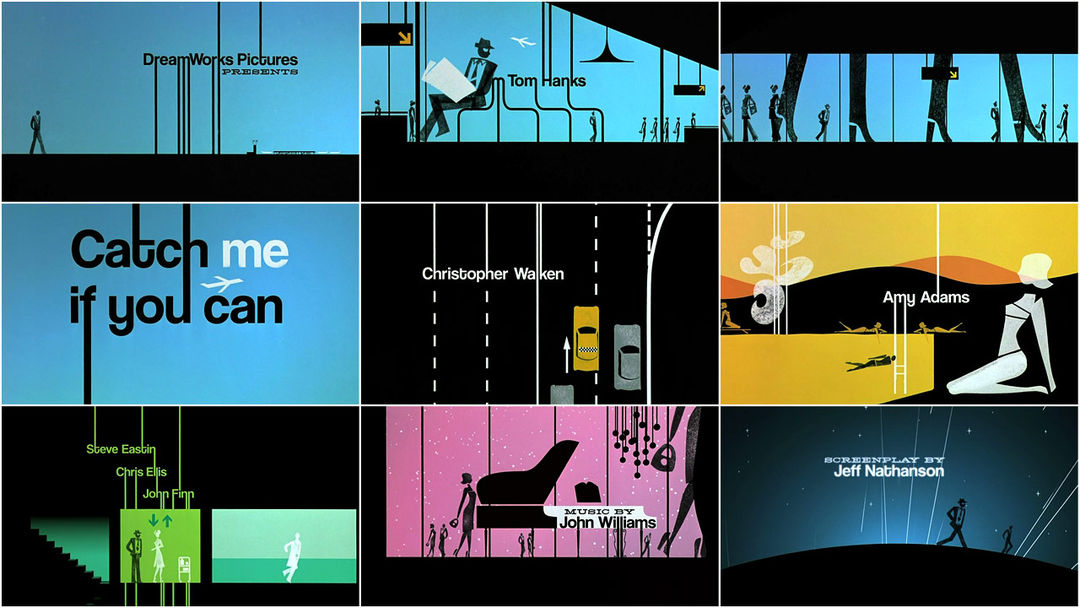
A few weeks ago, I watched the Steven Spielberg film Catch Me If You Can. I really enjoyed the film, but the thing that grabbed me right at the start was the title sequence. It is a very minimalistic animation that draws the viewer in and tells a story of its own. Just through silhouettes, it is able to capture the essence of the characters and tell their story. Even more impressive is the fact that the characters were not animated digitally. Rather, the creators made stamps of the characters and animated with those. There's a lot more detail on the process and other aspects of creating the titles in an interview on the Art of the Title page. Unfortunately I can't get the video to embed, but it is also available on the same page.
Subscribe to:
Posts
(
Atom
)