Showing posts with label Catch Me If You Can. Show all posts
Showing posts with label Catch Me If You Can. Show all posts
Thursday, April 21, 2016
Catch Me If You Can and Saul Bass

Thursday, September 10, 2015
History of Titles
On Monday, our name title is doing. I was doing research to figure out what I wanted my brand to be and I came across this video about the history of movie titles. I found it very interesting and I thought I should share it with you all since we will have a project where we have to change a title. Take a look:
I find it so cool to see the progression of technology from the early 1900's to today. We went from still slides to actual cool animations. And just from the few classes that we've had so far I'm blown away what After Effects can do and we've barely touched it. As someone who has no artistic ability, it's cool to see that there are so many possibilities I can do with a program, even if I don't have the talent for it.
Friday, October 24, 2014
Catch Me If You Can: A Story in a Title Sequence
The first time I saw Catch Me If You Can, I didn’t really
have much idea of what the movie was going to be about. My knowledge going in
was Tom Hanks, Leonardo DiCaprio, and a dream. The title sequence for this
movie is pretty cool and sort of sets you in the mindset for the movie. The
sequence itself actually tells the entire story of the movie in just 2.5
minutes. With no knowledge of the plot at all, I didn’t catch this on my first
view, but the style and execution of the sequence gave me an idea and something
to expect. I entire sequence is a little bit whimsical and a little bit
mysterious. The illustrations are easy and the colors are nice and it’s pretty
easy to follow the story the title sequence is telling. After seeing the movie
and knowing exactly the story the title sequence is telling, I can appreciate
those colors even more. The color change from scene to scene within the
sequence is a very deliberate reference to the overarching theme of the movie.
I think it was handled in a very cool way. It’s amazing that you can tell the full story of a 2.5 hour star-studded movie in just 2.5 minutes using cartoons and colors.
Friday, May 3, 2013
TItle Sequence: Catch Me If You Can
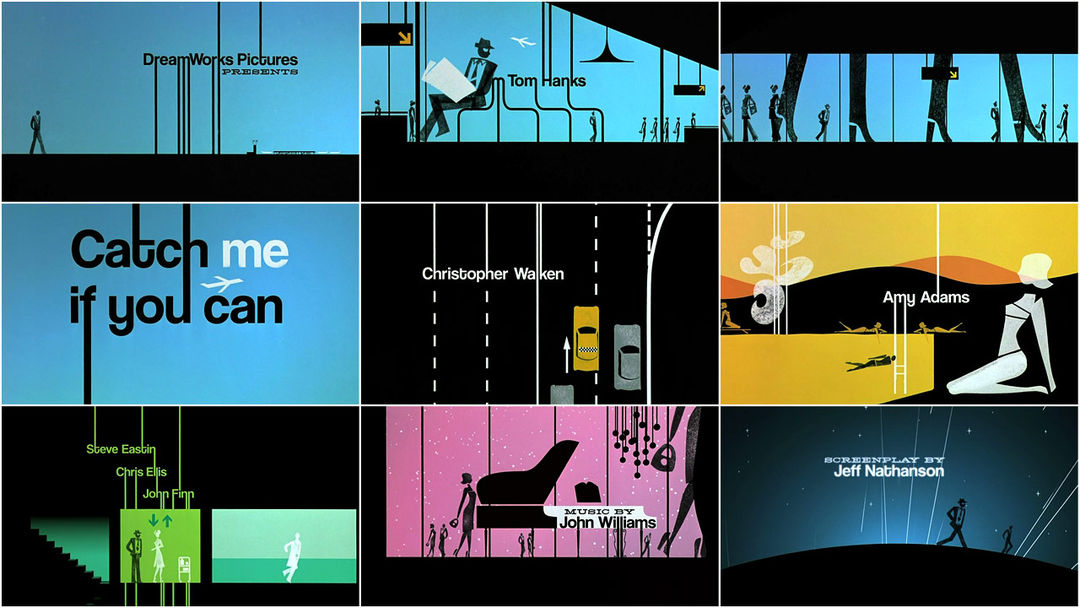
A few weeks ago, I watched the Steven Spielberg film Catch Me If You Can. I really enjoyed the film, but the thing that grabbed me right at the start was the title sequence. It is a very minimalistic animation that draws the viewer in and tells a story of its own. Just through silhouettes, it is able to capture the essence of the characters and tell their story. Even more impressive is the fact that the characters were not animated digitally. Rather, the creators made stamps of the characters and animated with those. There's a lot more detail on the process and other aspects of creating the titles in an interview on the Art of the Title page. Unfortunately I can't get the video to embed, but it is also available on the same page.
Thursday, March 21, 2013
Catch Me If You Can
I absolutely love this title sequence for Steven Spielberg's "Catch Me If You Can" (2002). I think it does a fantastic job at setting the stage for this great cat and mouse crime thriller. It also does a great job at introducing the amazing score by John Williams. This might be a stretch, but the animation reminds me a little bit of the hand animations of Norman McLaren. The way in which the lines interact with the pacing of the music is a lot like the way objects interact with the music in McLaren films.
Saturday, February 18, 2012
Catch Me If You Can
In the past week's class we have been talking about and looking at the website "Forget the Film, Watch the Title," after browsing this website for a while and checking out the various title sequences that were present on the site, I decided to look for similar sequences in various types of media I watch. Two days ago I watched "Catch Me If You Can" with my roommates and was really intrigued by the opening credits. It seems to be simple but very interesting and unique. Many individuals have referenced this title as being inspired by Saul Bass, who was a graphic designer and filmmaker, best known for his design of film poster and motion picture title sequences. One fascinating aspect was that the characters went for a "stamp-style" animation, in which stamps were actually used to generate the characters. I also would like to know how exactly the did certain aspects of the animation, such as the light bulbs turning on and the character appearing there. Also when the plane flies across and the "me" looks almost like a cloud. This opening credit sequence was created by Nexus Productions. Here's the opening title, so check it out, and enjoy!
Sunday, September 11, 2011
Catch Me If You Can

A little research into this title sequence shows that the creators used Autodesk software to create the scene. The style, font, and everything else about the entire sequence takes the viewer back to the time period in which the film takes place, the 1960s. There is a beautiful use of the moving lines in the scene to not only tell the story, but to also write out the title itself, as well as the cast and crew in the opening credits.
The scene shows how motion graphics even in the most simplest of ways can do an incredibly effective job in an opening sequence, and leave a profound impact on the audience for years to come!
Subscribe to:
Posts
(
Atom
)