Showing posts with label Wes Anderson. Show all posts

Thursday, September 24, 2015

Title Sequence Project

For our next project I am in between ideas. Earlier this week I was reeling through different movies like "Sherlock Holmes", "Fight Club", "Pan's Labyrinth"; all movies that have a certain aesthetic that would be relatively simple to convey in a title sequence, but decided against them because I didn't want to recreate already made titles or felt that I could make one that fit the movies tone.

My mind immediately went to this stained and drawing look from "Sherlock Holmes"

Now I am between two very different ideas. One would be Wes Anderson's "The Grand Budapest Hotel". His greatest strengths in his movies are the stylized vintage-pastel aesthetic, which I feel could easily translate to a simple title sequence. 


My other idea would be for "Over the Garden Wall", a twisted cartoon that follows two brothers into the dangerous "Unknown" woods. I feel that a 2D animation of the brothers walking through different significant scenes would be a good start for the title project. 


Thursday, September 17, 2015

Animation Favorites

So for my post this week I decided to share my favorite animated TV show and my favorite animated movie.

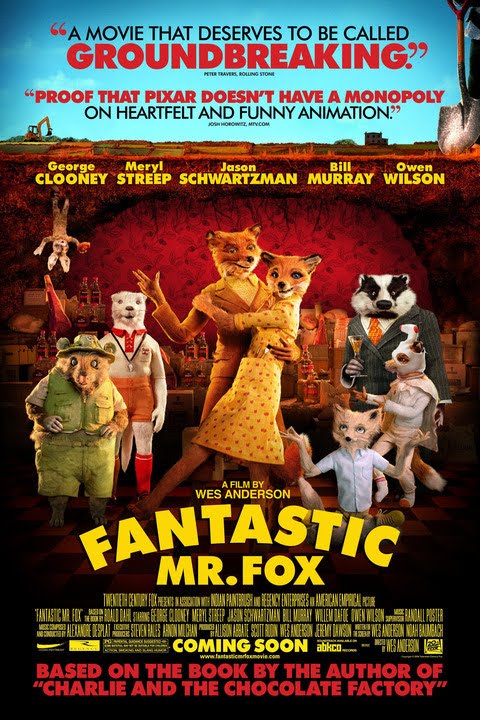
1) Fantastic Mr. Fox
I know that this movie was in my post from last week, but I am posting about it again because I really love this movie. This is Wes Anderson's only animated movie so far, and he absolutely nailed it! This movie is so aesthetically amazing, as well as having a stellar cast and a great story. The animation in this movie is so wonderful. Every thing whether is be a tree, an animal, the hunters, a house, anything has its own energy in the film. Also the use of color in this film is brilliant, everything is so vibrant and beautiful. I also love that it is stop motion.

2) The Legend of Korra
Nickelodeon had a show called Avatar the Last Airbender which was a show in which people in this fictional version of the world could control elements through a force called "bending" each person can only control one element except for the Avatar who could control all four elements, and existed to bring harmony to the world. After the first show ended, Nickelodeon decided to reboot it. Korra is the new avatar to the same world, but with a new set of problems. This show is awesome because the animation involves people controlling fire, water, earth and air, so each of these elements has a different vibe so they need to move differently. The animators did a great job of making each element act differently. Fire was a lot of bursts and short quick movements, water was very smooth and fluid, air was light with a lot spirals and quick movements, and earth was a lot of levitating solid forms and pushing or pulling. I highly recommend this show to everyone.

Thursday, September 10, 2015

Stop Motion Animation

So in class Arturo was talking about how not all of our animation has to be computer generated, and he mentioned stop motion animation. This wasn't the first time I had ever heard of stop motion or anything, however it did get me thinking about it.

First, my mind immediately went to the TV show Parks and Recreation. In the show, when a character named Ben gets fired from his job and decides to start up a stop motion film. After a few weeks of non-stop working on his film he finally shows it to his friends and this is the end result
As you can see, the show is kind of making fun of how hard stop motion animation can be if you do not have the help of a professional. I was thinking about the process of making them, and how now a days even with the quality of cameras that we have access to, it still takes roughly 10 shots for every one second of film.

So next I went online and found some other really cool stop motion videos, that while must have taken a lot of work, look really cool.
As you can see this video is made entirely with post it notes. Each variation of each of these images had to have been created, then photographs and then slightly changes, and then photographed again, and so on and so forth. This video is also cool because it shows that anyone with a camera and an idea can make a stop motion video or film. It also proves that not all stop motion, is made with clay

After some time spent watching videos like this online, I started to get more and more interested in stop motion, and then when I thought more about it, I remembered that one of my favorite movies is a stop motion film. Fantastic Mr. Fox came out in 2009 and is a film by Wes Anderson. It follows the life of Mr. Fox and his family and friends. As a Fox, Mr. Fox spent most of his life stealing things from the farmers that live above his borough, although he says that he has given that life up when he started a family, he soon returns to his life of crime.
This movie is absolutely beautiful in its use of stop motion to show the story of this crazy fox and his family. So while you can still make a pretty cool film with just your camera and some post its, the quality of stop motion animation can be absolutely astounding. I think that is pretty cool.

Tuesday, April 29, 2014

Unnoticed VFX Vs.Big Budget VFX

 Everyone always blogging and talking about the big blockbusters with huge budgets and amazing special effects that really stand out to the audience. But what about the smaller budget movies that have visual effects that people don't notice. The visual effect that are subtle that are hidden from the viewer. Wes Anderson  does a great job of this is "The Grand Budapest Hotel". For the people that don't know who Wes Anderson is, a American director and screenwriter. His films are known for their distinctive visual and narrative style. You might know him for the academy award for best animated feature for "Fantastic Mr. Fox" back in 2009. In the video below it shows the small sets that they went through from green screen to miniature sets but it shows more than just the miniature sets that went into this movie. 


For a big blockbuster like gravity it is no surprise that it has won seven awards and was such a hit in the box office. Alfonso Cuarón’s 3D space epic "Gravity" leads the 86th annual Academy Awards with seven wins, including the prize for best visual effects. Gravity has taken in $704.9 million globally including $270.5 at the domestic box office and $424.4 internationally. The video below talks about the film from script to screen and it really shows the narrative behind the dramatic story. 


Sunday, March 30, 2014

Wes Anderson is Living in his Own World

I had a lot of anticipation before going in to see Wes Anderson's newest film, The Grand Budapest Hotel. I've always been fairly neutral about Anderson, and part of me was hoping that this one, with it's almost universal acclaim and pretty massive amounts of hype, might sway me to be more in favor of him. I love some of his earlier movies and Fantastic Mr. Fox - part of me wants Anderson to exclusively make animated films - but I was pretty ambivalent on 2012's Moonrise Kingdom: it just didn't really do anything for me.


Well, unfortunately, Budapest didn't change anything. It's Wes Anderson at his most Wes Anderson-y. The colors are bright, the special effects are delightfully terrible, and there's a lot of A-list actors giving extremely odd - but great - performances. Things are symmetrical and perfectly framed. The dialogue is bizarre and irreverent and borders on being depressing. It's a dark comedy wrapped up in a big, colorful, pink and purple box.

You have to give it Anderson, however, for picking a style and sticking with it. It's unique, it's fresh, and it's his own. Apart from the already brilliant set design and colors in Budapest, there are a few colorizing techniques and effects added in post that I was really impressed by. The movie actually tells three stories from three different time periods: the main one being told in the 30's, the second being in the late 60s, and the last one in the 80s. Each time period was given their own respective color scheme and aspect ratio, and this helped to tell each story and really make them pop. The 30's has an aspect ratio of 1.37, which is an older, almost boxy view, and here is where the colors were much more brighter and saturated. In the 80s, he used a typical 1.85 ratio, and a 2.35:1 anamorphic (giving it a more rounded look) ratio for the 60s, where he also focused more on the gold and green colors.

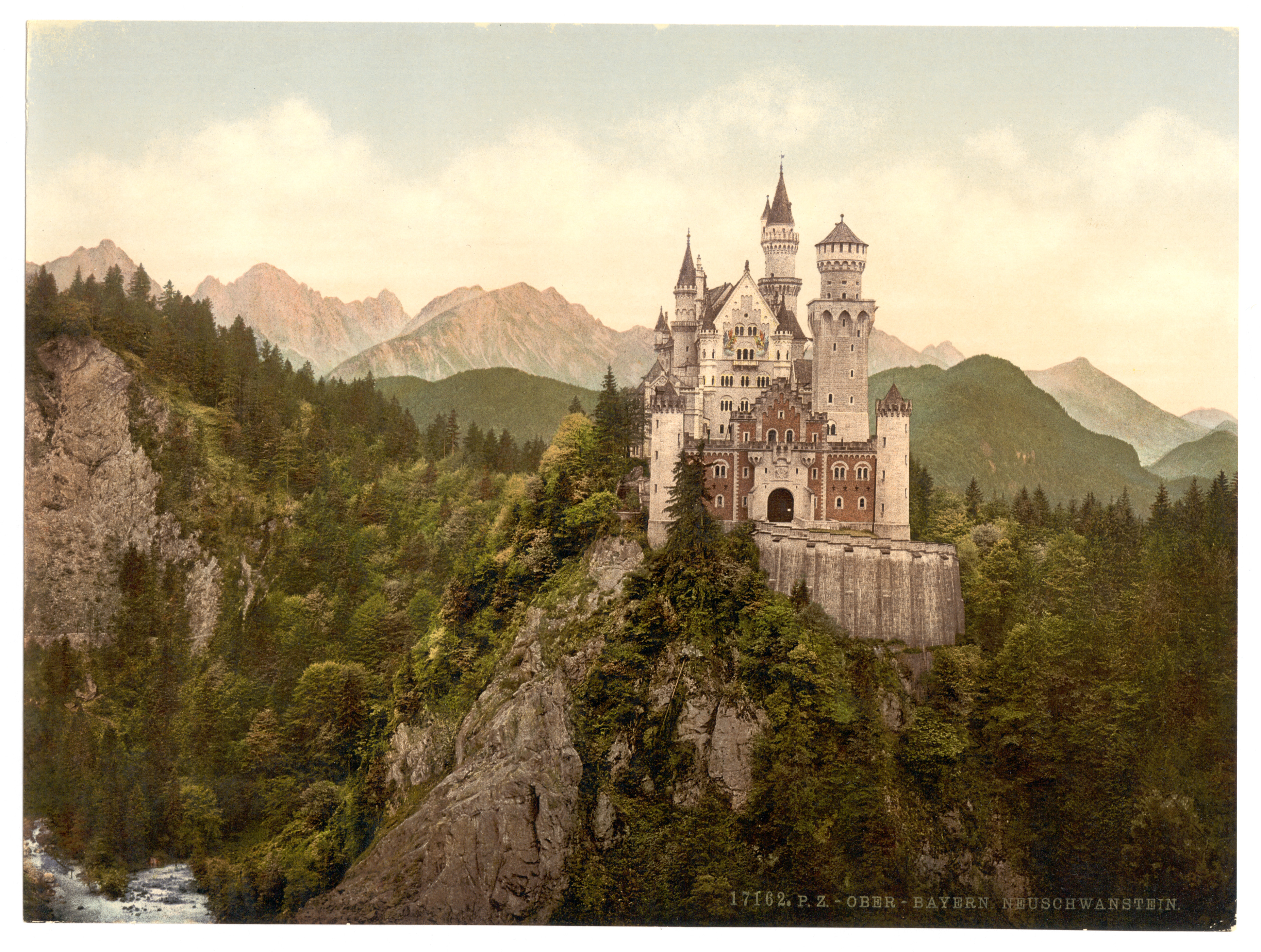
Jill Bogdanowicz, who, I must say, has one hell of a resume, acted as the digital intermediate colorist for the film, which means she was involved with the grading, which she did on Da Vinci Resolve (a color correction program that Arturo recommends). She did an interview with Studio Daily about working so close with Wes Anderson, and the whole thing is a pretty interesting read. You can find it here. One thing from that article that I found particularly interesting is how Anderson used Photochrom (think an early version of Instagram) as an influence for how he wanted certain segments of Budapest to look. I think it's pretty easy to see the similarities, particularly in the film's poster.

One last thing I found was a way to replicate the anamorphic aspect ratio that Anderson uses in many of his films. It's almost like a subtle fish-eye distortion, with the edges of the frame seemingly bending to give things a rounded look. You can watch the video to see what I'm talking about - and how it's applicable to your own work - and go to the website to download plugins for After Effects here.