So on one fateful day last may, two of the worlds greats came together to create one of the most absolutely spectacular half hours of television ever created. These two greats are The Simpsons, and LEGO, and they bestowed upon us the masterpiece that is "Brick Like Me". This is the LEGO episode and the 550th episode of The Simpsons.
The episode is set in the idealistic and basically perfect world that is the LEGO universe. All is well until Homer starts to see visions of his other life back in the Springfield that we all know and love. Throughout the episode more and more of his old life leaks into his new one in the LEGO world, and in the end, he must decide to stay in this new near perfect brick world, or to return to his old 2D classic world.
This episode took two year to get on air, and took over twice as long as a normal episode would to make. I would say that it was definitely well worth the wait! This episode is so beautifully crafted it almost hurts. The LEGO version of Springfield is so bright and brilliant, but still has the hilarious vibe of the Springfield we've know for over 500 episodes. It also added some new comedy to the show when dealing with things that only LEGO people have to deal with; like the water,
and being able to mix the two kinds of animation that LEGO and The Simpsons both are giants in.
From animation, to story, this episode is absolutely brilliant, and I loved watching it on its premiere last summer, as well as over and over again after that. 10/10 would recommend
So, I know that the Lego Movie has been beaten to death on this blog but hear me out one last time. I was on YouTube earlier and stumbled upon a clip that went very in-depth behind the scenes with the creators and the animators who sat down and actually built the entire movie. They talk about how they used actual lego sets and macro images to build all of the buildings and everything in the movie. One thing they talk about is that you can stop any frame and build what you see in the movie because they used all real Lego pieces. They took pieces from the Lego databases and even built the pieces in 3D renderers from existing pieces so they could use them to enhance the story. This video shows the software and them creating the different things and a lot of the minute details, such as the broken spaceman helmet, that were used in the movie. They even talk about how they took a real life broken spaceman one of the creators had and built it specifically for the purposes of using it in the movie. Anyway, here is the video I hope you find it as interesting as I did.
Over the past few years, there has been an increased amount of commercialization between tangible toys and digital downloadable content. Companies such as Disney have been able to profit off of the success of toys such as Disney Infinity and Skylanders. Now Lego, in partnership with DC comics, is releasing Lego Dimensions, which follows the same business model as Disney. Buying this product allows access to downloadable in-game content. This drives consumers to both purchase new products as well as play the existing game. I am looking forward to seeing how this product competes in the existing market.
Stop animation is hard enough to do, but stop animation using legos is a whole new ballpark. This is what animated the music video for "Fell In Love With A Girl" by the White Stripes. Michel Gondry directed this video in 2002 and it would later win three MTV Video Music Awards for that year including Breakthrough Video, Best Special Effects, and Best Editing. The video was shot frame by frame and each frame had a completely rebuilt lego arrangement to simulate movement. This painstaking animation was something that hadn't been done before in a music video. The attention to detail and the planning that went into making this video is so easy to see. The lego blocks are brought to life and they create a great high-energy vibe to the music video.
I'm not much of an animation guy. I love cartoons and animated movies as much as anyone else, but I've never been fascinated by it the way some people are. I mean, let's be honest. I spent almost two hours today trying to make Chris Christie eat a Subway sandwich. And that came out subpar, at best (pun 100% intended). You could say it's not really my forte, but that would be putting it nicely. I guess that's one reason why I'm taking this class.
Which leads me to last weekend. I didn't see the Lego Movie on opening day because it was an animated film. I didn't see it because it looked funny, or even because Chris Pratt voices the main character. I saw The Lego Movie because - from the trailer alone - I got nostalgic. I don't think I've played with Legos - really played with them - in upwards of 8 or 9 years. That's almost half of my life; enough time to get appropriately nostalgic about plastic bricks, I think.
Stick with me: I'll tie this all together.
I loved The Lego Movie. Thought it was absolutely brilliant. The writing was about as perfect as it could be for a kids movie (entertaining for adults, but with enough silly humor and butt jokes to keep kids - and myself - laughing) and I was totally right about the whole film making me a bit nostalgic. But, surprisingly enough, the thing that really did it for me was the animation.
As was mentioned in the blog before, the animation is a weird mixture of what appears to be CGI and stop motion, even though I believe the whole thing is done digitally. The attention to detail is impeccable; Lego figures can only bend their legs about 90 degrees at the waist and can't move from side to side, all of the buildings and vehicles are comprised of billions and billions of tiny lego blocks, and nothing is perfectly fluid. The fire and water effects are particularly amazing and stop motion-esque. All done with the appearance of being lego bricks.
The film would absolutely not be such a success if had been animated differently; I can almost guarantee that. It made me feel like I was a kid again, sitting in my room with all my Legos, seeing what kind of crazy shit I could come up with and create. This movie reinforced what I've slowly been realizing about animation, and that is that a good story should not improve an animated film; it should be the other way around. The animation should be a reflection of the story you are trying to tell. The Lego movie took this in a very literal sense, and it turned out perfectly. I'm honestly not sure who to thank for this. There are the two directors, Phil Lord and Christopher Miller. But then there's also the massive list of people involved in actually animating the film, including the art team, special effects people, and even the cinematographers. To make life easier for everybody, I'll just leave the link to the IMDB page right here.
So while I may not be able to make any chubby governors eat five dollar footlongs, I'm starting to begin to appreciate the relationship between animation and writing a great story. And that's something that I like to think of as being my forte. Sorry Mike Levien; I know you had mixed opinions about The Lego Movie, but I personally thought everything was awesome.
Stop motion is highly articulate and not for the easily distracted and less-than-dedicated artist. It requires a substantial amount of time, patience and visionary talent, which is essentially why I have so much respect for those who can pull it off successfully. The choice of medium (Legos) used in the following video struck me, because - well, who hasn't imagined their legos coming to life when they were younger? Also interesting was the choice to use story elements from the Call of Duty: Black Ops series. Preferably, I would have liked to see Metal Gear Solid re-imagined with legos, but that's just me.
This little animation is a homage to the story of Lego, how the bricks came about from a Danish toymaker and how they have impacted the world.
This little animation has a style that resembles stop motion clay characters, and has a vast amount of interesting transitions and styles of lighting and texturing. The 3D animation is perfect for this kind of story because the bricks themselves can be molded to create any object in real life 3-dimensional space; to make a 2d animation about 3d bricks would be redundant.
This really shows that the style of animation has to fit the subject matter at hand. It must compliment, not take away from, the topic at hand. The animation itself should not be the focus; if you're audience is focused on the animation the whole time, then they haven't payed attention to what you were trying to say with the animation.
So I was wandering around the internet this weekend while I was on duty and I found this little production group called Brotherhood Workshop that makes fantasy story videos. The use A LOT of stop motion and I am not complaining about it. The first video I watched was this one where they took one of the new Lord of the Rings Lego sets and made the funny video below. They even edited in sparkling candle flames and torch flames! (Keep an eye out for Gollum and for a Star Wars cameo)
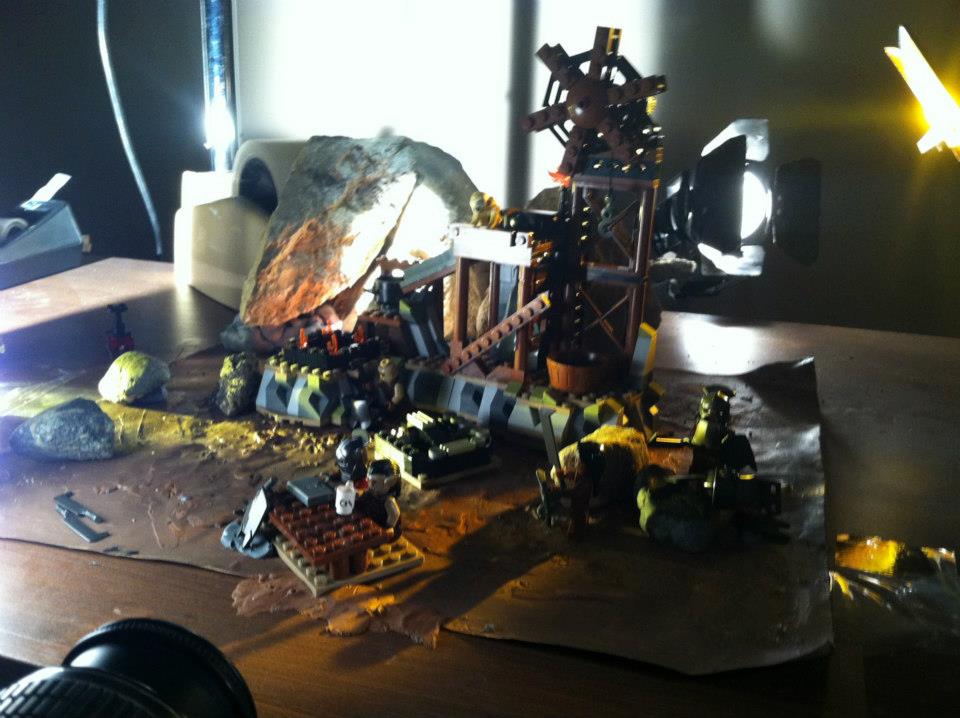
Here's an image from the behind the scenes of my favorite video called "Orcs" featuring two orcs, one chilling on a laptop and the other enjoying a mug of joe.
Each video seems to based on different Lord of the Rings lego sets but have a variety of other LOTR sets included in them. Watching these videos reminded me of when I was younger when my dad, brother, and I would sit around for hours making stop motion videos with the Legos my brother and I owned and then my dad helping us with recording the audio later. I would have included an example clip but those videos have been lost for many a year.
The holidays got me to thinking about what my favorite toys were growing up, and LEGOs came to mind. Not surprisingly, I wasn't the only person on the Internet looking to see informationa bout LEGO animations and how some could be done.
I actually got redirected to a Video Copilot forum in which some people were discussing different ways in which you could animate LEGOs, and most people came to the conclusion that you could either do very limited animation work using something like After Effects, or just use stop motion to animate. I'll give examples of both that I found on the forum.
This first example is one in which a guy put together a pretty basic video using some LEGOs and a green sheet in which he keyed in random desert images and changed the position of the LEGOs to give the pretty basic illusion of movement.
The stop motion versions of LEGO use are obviously more tedious but much more rewarding. The best example I found was this music video by The White Stripes: